MCQ
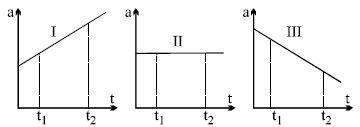
Each of the three graphs represents acceleration versus time for an object that already has a positive velocity at time $t_1$. Which graphs show an object whose speed is increasing for the entire time interval between $t_1$ and $t_2$ ?
  • A
    graph $I$, only
  • B
    graphs $I$ and $II$, only
  • C
    graphs $I$ and $III$, only
  • graphs $I, II$ and $III$

Answer

Correct option: D.
graphs $I, II$ and $III$
d
Acceleration is positive in all three cases

Need a full question paper?

Generate a complete, print-ready paper with questions like this in minutes — across 16+ boards, with answer keys.

Start Generating Free

Similar questions

The work done in which of the following processes is zero
In a process, temperature and volume of one mole of an ideal monoatomic gas are varied according to the relation $VT = K$, where $I$ is a constant. In this process the temperature of the gas is increased by $\Delta T$. The amount of heat absorbed by gas is ($R$ is gas constant)
What should be the angular speed with which the earth have to rotate on its axis so that a person on the equator would weigh $\frac{3}{5}$ th as much as present?
A quantity measured repeatedly many times with an instrument. The readings are shown in figure where $T$ represent true value of the measurement. Which of the following measurement is imprecise but accurate ?
A passenger inside a bus moving with uniform speed suddenly finds that a ball at rest, starts moving towards his left. It means that the bus now is
An ideal gas is subjected to an isothermal expansion such that its volume changes from $V_i$ to $V_f$ and pressure from $P_i$ to $P_f$. The work done on the gas is :
If two balls of same metal weighing $5\, gm$ and $10\, gm$ strike with a target with the same velocity. The heat energy so developed is used for raising their temperature alone, then the temperature will be higher
$Assertion$ : The error in the measurement of radius of the sphere is $0.3\%$. The permissible error in its surface area is $0.6\%$

$Reason$ : The permissible error is calculated by the formula $\frac{{\Delta A}}{A} = \frac{{4\Delta r}}{r}$

The frequency of oscillation of a mass $m$ suspended by a spring is $v_1$. If length of spring is cut to one third then the same mass oscillates with frequency $v_2$, then
A steel rail of length $5\,m$ and area of cross-section $40\,cm^2$ is prevented from expanding along its length while the temperature rises by $10\,^oC$. If coefficient of linear expansion and Young's modulus of steel are $1.2\times10^{-5}\, K^{-1}$ and $2\times10^{11}\, Nm^{-2}$ respectively, the force developed in the rail is approximately