MCQ
The work done in which of the following processes is zero
  • A
    Isothermal process
  • B
    Adiabatic process
  • Isochoric process
  • D
    None of these

Answer

Correct option: C.
Isochoric process
c
(c) $W = P\Delta V = 0$ (As$\Delta V = 0$)

Need a full question paper?

Generate a complete, print-ready paper with questions like this in minutes — across 16+ boards, with answer keys.
Start Generating Free

Similar questions

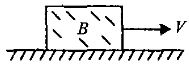
A block $B$ is pushed momentarily along a horizontal surface with an initial velocity $V.$ If $\mu $ is the coefficient of sliding friction between $B$ and the surface, block $B$ will come to rest after a time
The potential energy function for the force between two atoms in a diatomic molecule is approximately given by $U(x)=$ $\;\frac{a}{{{x^{12}}}} - \frac{b}{{{x^6}}}$ where a and b are constants and $x $ is the distance between the atoms. If the dissociation energy of the molecule is $D = [ U ( x = \infty) - U_{ at\ equilibrium}], D$ is
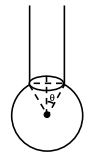
When liquid medicine of density $\rho$ is to be put in the eye, it is done with the help of a dropper. As the bulb on the top of the dropper is pressed, a drop forms at the opening of the dropper. We wish to estimate the size of the drop. We first assume that the drop formed at the opening is spherical because that requires a minimum increase in its surface energy. To determine the size, we calculate the net vertical force due to the surface tension $T$ when the radius of the drop is $\mathrm{R}$. When the force becomes smaller than the weight of the drop, the drop gets detached from the dropper.

$1.$ If the radius of the opening of the dropper is $\mathrm{r}$, the vertical force due to the surface tension on the drop of radius $R$ (assuming $\mathrm{r} \ll R$ ) is

$(A)$ $2 \pi r T$ $(B)$ $2 \pi R T$ $(C)$ $\frac{2 \pi r^2 T}{R}$ $(D)$ $\frac{2 \pi R^2 T}{r}$

$2.$ If $\mathrm{r}=5 \times 10^{-4} \mathrm{~m}, \rho=10^3 \mathrm{~kg} \mathrm{~m}^{-3}, \mathrm{~g}=10 \mathrm{~m} / \mathrm{s}^2, \mathrm{~T}=0.11 \mathrm{Nm}^{-1}$, the radius of the drop when it detaches from the dropper is approximately

$(A)$ $1.4 \times 10^{-3} \mathrm{~m}$ $(B)$ $3.3 \times 10^{-3} \mathrm{~m}$

$(C)$ $2.0 \times 10^{-3} \mathrm{~m}$ $(D)$ $4.1 \times 10^{-3} \mathrm{~m}$

$3.$ After the drop detaches, its surface energy is

$(A)$ $1.4 \times 10^{-6} \mathrm{~J}$ $(B)$ $2.7 \times 10^{-6} \mathrm{~J}$

$(C)$ $5.4 \times 10^{-6} \mathrm{~J}$ $(D)$ $8.1 \times 10^{-6} \mathrm{~J}$

Give the answer question $1,2$ and $3.$
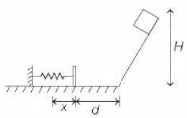
A block of mass $m$ slides from rest at a height $H$ on a frictionless inclined plane as shown in the figure. It travels a distance $d$ across a rough horizontal surface with coefficient of kinetic friction $\mu$ and compresses a spring of spring constant $k$ by a distance $x$ before coming to rest momentarily. Then the spring extends and the block travels back attaining a final height of $h$. Then,
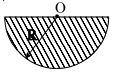
Moment of inertia of a thin semicircular disc (mass $= M$ & radius $= R$) about an axis through point $O$ and perpendicular to plane of disc, is given by :
Two bodies moving towards each other collide and move away in opposite directions. There is some rise in temperature of bodies because a part of the kinetic energy is converted into
A large number of bullets are fired in all directions with same speed $v$. What is the maximum area on the ground on which these bullets will spread
The length of a simple pendulum is increased by $1\%$. Its time period will
A car is moving at a speed of $40\,m/s$ on a circular track of radius $400\,m.$ This speed is increasing at the rate of $3\,m/s^2.$ The acceleration of car is  ........ $m/s^2$
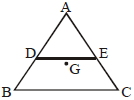
$ABC$ is a plane lamina of the shape of an equilateral triagnle. $D,$ $E$ are mid points of $AB$, $AC$ and $G$ is the centroid of the lamina. Moment of inertia of the lamina about an axis passing through $G$ and perpendicular to the plane $ABC$ is $I _{0} .$ If part $ADE$ is removed, the moment of inertia of the remaining part about the same axis is $\frac{ NI _{0}}{16}$ where $N$ is an integer. Value of $N$ is