MCQ
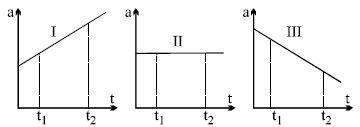
Each of the three graphs represents acceleration versus time for an object that already has a positive velocity at time $t_1$. Which graphs show an object whose speed is increasing for the entire time interval between $t_1$ and $t_2$ ?
  • A
    graph $I$, only
  • B
    graphs $I$ and $II$, only
  • C
    graphs $I$ and $III$, only
  • graphs $I, II$ and $III$

Answer

Correct option: D.
graphs $I, II$ and $III$
d
Acceleration is positive in all three cases

Need a full question paper?

Generate a complete, print-ready paper with questions like this in minutes — across 16+ boards, with answer keys.

Start Generating Free

Similar questions

The bulk modulus of copper is $1.4 × 10^{11}$ $Pa$ and the coefficient of linear expansion is $1.7 × 10^{-5} (C^o )^{-1}$. What hydrostatic pressure is necessary to prevent a copper block from expanding when its temperature is increased from $20^o C$ to $30^o C$
Find the value of $\frac{1.53 \times 0.9995}{1.592}$ with due regard for significant figures
The variation of density of a cylindrical thick and long rod, is $\rho  = {\rho _0}\frac{{{x^2}}}{{{L^2}}}$ , then position of its centre of mass from $x = 0$ end is
A tank is filled up to a height $2H$ with a liquid and is placedon a platform of height $H$ from the ground. The distance $x$ from the ground where a small hole is punched to get the maximum range $R$ is:
Two planets have the same average density but their radii are ${R_1}$ and ${R_2}$. If acceleration due to gravity on these planets be ${g_1}$ and ${g_2}$ respectively, then
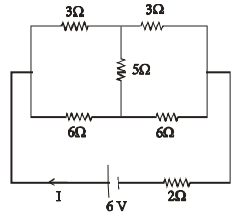
A battery of $6\,V$ is connected to the circuit as shown below. The current I drawn from the battery is:
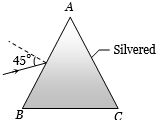
A prism $ABC$ of angle $30^o $ has its face $AC$ silvered. A ray of light incident at an angle of $45^o $ at the face $AB$ retraces its path after refraction at face $AB$ and reflection at face $AC$. The refractive index of the material of the prism is
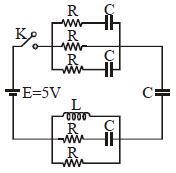
Find the current passing through battery immediately after key $(K)$ is closed. It is given  that initially all the capacitors are uncharged......$A$ (Given that $R = 6\,\Omega$ and $C = 4\, \mu F$)
Three identical vessels are filled to the same height with three different liquids $A, B$ and $C$  $({\rho _A} > {\rho _B} > {\rho _C})$. The pressure at the base will be
We have two (narrow) capillary tubes $T_1$ and $T_2$. Their lengths are $l_1$ and $l_2$ and radii of cross-section are $r_1$ and $r_2$ respectively. The rate of flow of water under a pressure difference $ P$  through tube $T_1$ is $8cm ^3/sec$. If $l_1 = 2l_2$ and $ r_1 =r_2$, what will be the rate of flow when the two tubes are connected in series and pressure difference across the combination is same as before $ (= P)$