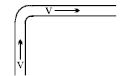
We have two (narrow) capillary tubes $T_1$ and $T_2$. Their lengths are $l_1$ and $l_2$ and radii of cross-section are $r_1$ and $r_2$ respectively. The rate of flow of water under a pressure difference $ P$ through tube $T_1$ is $8cm ^3/sec$. If $l_1 = 2l_2$ and $ r_1 =r_2$, what will be the rate of flow when the two tubes are connected in series and pressure difference across the combination is same as before $ (= P)$
Diffcult


Download our appand get started for free
Experience the future of education. Simply download our apps or reach out to us for more information. Let's shape the future of learning together!No signup needed.*
Similar Questions
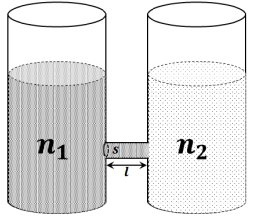
- 1As shown schematically in the figure, two vessels contain water solutions (at temperature $T$ ) of potassium permanganate $\left( KMnO _4\right)$ of different concentrations $n_1$ and $n_2\left(n_1>n_2\right)$ molecules per unit volume with $\Delta n=\left(n_1-n_2\right) \ll n_1$. When they are connected by a tube of small length $\ell$ and cross-sectional area $S , KMnO _4$ starts to diffuse from the left to the right vessel through the tube. Consider the collection of molecules to behave as dilute ideal gases and the difference in their partial pressure in the two vessels causing the diffusion. The speed $v$ of the molecules is limited by the viscous force $-\beta v$ on each molecule, where $\beta$ is a constant. Neglecting all terms of the order $(\Delta n)^2$, which of the following is/are correct? ( $k_B$ is the Boltzmann constant)-View Solution
$(A)$ the force causing the molecules to move across the tube is $\Delta n k_B T S$
$(B)$ force balance implies $n_1 \beta v \ell=\Delta n k_B T$
$(C)$ total number of molecules going across the tube per sec is $\left(\frac{\Delta n}{\ell}\right)\left(\frac{k_B T}{\beta}\right) S$
$(D)$ rate of molecules getting transferred through the tube does not change with time
- 2A fluid is flowing through a horizontal pipe of varying cross-section, with speed $v\;ms^{-1}$ at a point where the pressure is $P$ Pascal. At another point where pressure is $\frac{ P }{2}$ Pascal its speed is $V\;ms^{-1}$. If the density of the fluid is $\rho\, kg\, m ^{-3}$ and the flow is streamline, then $V$ is equal toView Solution
- 3Suppose you have taken a dilute solution of oleic acid in such a way that its concentration becomes $0.01 \,cm ^{3}$ of oleic acid per $cm ^{3}$ of the solution. Then you make a thin film of this solution (monomolecular thickness) of area $4\, cm ^{2}$ by considering $100$ spherical drops of radius $\left(\frac{3}{40 \pi}\right)^{\frac{1}{3}} \times 10^{-3}\, cm .$ Then the thickness of oleic acid layer will be $x \times 10^{-14} \,m$. Where $x$ is ...... .View Solution
- 4The atmospheric pressure and height of barometer column is $10^5\,Pa$ and $760\,mm$ respectively on the Earth surface. If the barometer is taken to the Moon then column height will be ........ $mm$View Solution
- 5View SolutionWhich of the following is not the characteristic of turbulent flow
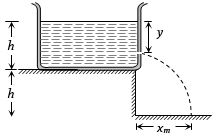
- 6A tank is filled upto a height $h$ with a liquid and is placed on a platform of height h from the ground. To get maximum range ${x_m}$ a small hole is punched at a distance of $y$ from the free surface of the liquid. ThenView Solution
- 7A cylindrical vessel of height $500 \mathrm{~mm}$ has an orifice (small hole) at its bottom. The orifice is initially closed and water is filled in it up to height $\mathrm{H}$. Now the top is completely sealed with a cap and the orifice at the bottom is opened. Some water comes out from the orifice and the water level in the vessel becomes steady with height of water column being $200 \mathrm{~mm}$. Find the fall in height (in ${m m}$ ) of water level due to opening of the orifice.View Solution
|Take atmospheric pressure $=1.0 \times 10^5 \mathrm{~N} / \mathrm{m}^2$, density of water $=1000 \mathrm{~kg} / \mathrm{m}^3$ and $g=10 \mathrm{~m} / \mathrm{s}^2$. Neglect any effect of surface tension.]
- 8A silver ingot weighing $2.1 kg$ is held by a string so as to be completely immersed in a liquid of relative density $0.8$. The relative density of silver is $10.5$ . The tension in the string in $kg-wt$ isView Solution
- 9Fountains usually seen in gardens are generated by a wide pipe with an enclosure at one end having many small holes. Consider one such fountain which is produced by a pipe of internal diameter $2$ $cm$ in which water flows at a rate $3$ $ms^{^{-1}}$. The enclosure has $100$ holes each of diameter $0.05$ $cm$. The velocity of water coming out of the holes ids ( in $ms^{^{-1}}$)View Solution
- 10A fire hydrant delivers water of density $\rho $ at a volume rate $L$. The water travels vertically upward through the hydrant and then does $90^o$ turn to emerge horizontally at speed $V$. The pipe and nozzle have uniform cross-section throughout. The force exerted by the water on the corner of the hydrant isView Solution