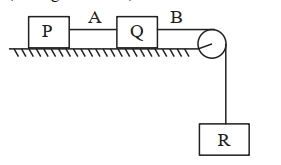
Each of three blocks $P$, $Q$ and $R$ shown in figure has a mass of $3 \mathrm{~kg}$. Each of the wire $A$ and $B$ has cross-sectional area $0.005 \mathrm{~cm}^2$ and Young's modulus $2 \times 10^{11} \mathrm{~N} \mathrm{~m}^{-2}$. Neglecting friction, the longitudinal strain on wire $B$ is____________ $\times 10^{-4}$. $\left(\right.$ Take $\mathrm{g}=10 \mathrm{~m} / \mathrm{s}^2$ )
JEE MAIN 2024, Diffcult
Download our app for free and get started
$ a=\frac{10}{3} \mathrm{~m} / \mathrm{s}^2 $
$ 30-T_1=3 \times a $
$ T_1=20 \mathrm{~N} $
$ \text { strain }=\frac{\text { stress }}{Y} $
$ =2 \times 10^{-4}$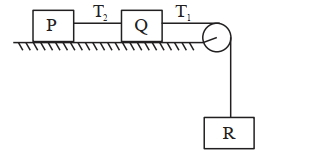

Download our appand get started for free
Experience the future of education. Simply download our apps or reach out to us for more information. Let's shape the future of learning together!No signup needed.*
Similar Questions
- 1Young's modulus is determined by the equation given by $\mathrm{Y}=49000 \frac{\mathrm{m}}{\ell} \frac{\text { dyne }}{\mathrm{cm}^2}$ where $\mathrm{M}$ is the mass and $\ell$ is the extension of wre used in the experiment. Now error in Young modules $(\mathrm{Y})$ is estimated by taking data from $M-\ell$ plot in graph paper. The smallest scale divisions are $5 \mathrm{~g}$ and $0.02$ $\mathrm{cm}$ along load axis and extension axis respectively. If the value of $M$ and $\ell$ are $500 \mathrm{~g}$ and $2 \mathrm{~cm}$ respectively then percentage error of $\mathrm{Y}$ is :View Solution
- 2View SolutionThe substances having very short plastic region are
- 3The density and breaking stress of a wire are $6 \times$ $10^4 \mathrm{~kg} / \mathrm{m}^3$ and $1.2 \times 10^8 \mathrm{~N} / \mathrm{m}^2$ respectively. The wire is suspended from a rigid support on a planet where acceleration due to gravity is $\frac{1^{\text {rd }}}{3}$ of the value on the surface of earth. The maximum length of the wire with breaking is ............ $\mathrm{m}$ (take, $\mathrm{g}=$ $\left.10 \mathrm{~m} / \mathrm{s}^2\right)$View Solution
- 4Wires $A$ and $B$ are made from the same material. $A$ has twice the diameter and three times the length of $B.$ If the elastic limits are not reached, when each is stretched by the same tension, the ratio of energy stored in $A$ to that in $B$ isView Solution
- 5View SolutionWhich one of the following substances possesses the highest elasticity
- 6In a series combination of copper and steel wires of same length and same diameter, a force is applied at one of their ends while the other end is kept fixed. The combined length is increased by $2\, cm$. The wires will have ..........View Solution
- 7An elastic material of Young's modulus $Y$ is subjected to a stress $S$. The elastic energy stored per unit volume of the material isView Solution
- 8Young's modulus of rubber is ${10^4}\,N/{m^2}$ and area of cross-section is $2\,c{m^2}$. If force of $2 \times {10^5}$ dynes is applied along its length, then its initial length $l$ becomesView Solution
- 9$Assertion :$ Solids are least compressible and gases are most compressible.View Solution
$Reason :$ solids have definite shape and volume but gases do not have either definite shape or definite volume. - 10A $5\, m$ long aluminium wire ($Y = 7 \times {10^{10}}N/{m^2})$ of diameter $3\, mm$ supports a $40\, kg$ mass. In order to have the same elongation in a copper wire $(Y = 12 \times {10^{10}}N/{m^2})$ of the same length under the same weight, the diameter should now be, in $mm.$View Solution