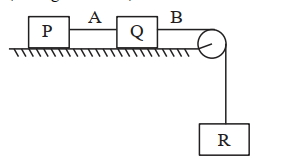
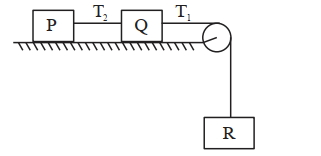
Each of three blocks $P$, $Q$ and $R$ shown in figure has a mass of $3 \mathrm{~kg}$. Each of the wire $A$ and $B$ has cross-sectional area $0.005 \mathrm{~cm}^2$ and Young's modulus $2 \times 10^{11} \mathrm{~N} \mathrm{~m}^{-2}$. Neglecting friction, the longitudinal strain on wire $B$ is____________ $\times 10^{-4}$. $\left(\right.$ Take $\mathrm{g}=10 \mathrm{~m} / \mathrm{s}^2$ )
JEE MAIN 2024, Diffcult


Download our appand get started for free
Experience the future of education. Simply download our apps or reach out to us for more information. Let's shape the future of learning together!No signup needed.*
Similar Questions
- 1View SolutionOn stretching a wire, the elastic energy stored per unit volume is
- 2The increase in length is $l$ of a wire of length $L$ by the longitudinal stress. Then the stress is proportional toView Solution
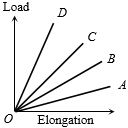
- 3View SolutionThe load versus elongation graph for four wires of the same material is shown in the figure. The thickest wire is represented by the line
- 4View SolutionDue to addition of impurities, the modulus of elasticity
- 5Two wire $A$ and $B$ are stretched by same force. If, for $A$ and $B, Y_A: Y_B=1: 2, r_A: r_B=3: 1$ and $L_A: L_B=4: 1$, then ratio of their extension $\left(\frac{\Delta L_A}{\Delta L_B}\right)$ will be .............View Solution
- 6In steel, the Young's modulus and the strain at the breaking point are $2 \times {10^{11}}\,N{m^{ - 2}}$ and $0.15$ respectively. The stress at the breaking point for steel is thereforeView Solution
- 7Join details of Column$-II$ with given information in Column$-I$ appropriatelyView Solution
Column $-I$ Column $-II$ $(a)$ Stress is proportional to strain.
$(i)$ Elastic limit $(b)$ When the load of the wire is removed, the body does regain its original dimension. $(ii)$ Limit of pro-portionality $(iii)$ Plastic deformation - 8Given : $\sigma$ is the compressibility of water, $\rho$ is the density of water and $K$ is the bulk modulus of water. What is the energy density of water at the bottom of a lake $‘h’$ metre deep ?View Solution
- 9If the potential energy of a spring is $V$ on stretching it by $2\, cm$, then its potential energy when it is stretched by $10 \,cm$ will beView Solution
- 10View SolutionThe breaking stress of a wire depends upon