MCQ
Earth's magnetic field always has a horizontal component except at or Horizontal component of earth's magnetic field remains zero at
  • A
    Equator
  • Magnetic poles
  • C
    A latitude of $60^o$
  • D
    An altitude of $60^o$

Answer

Correct option: B.
Magnetic poles
b
(b)At magnetic poles, the angle of dip is $90^o$. Hence the horizontal component ${B_H} = B\cos \theta = 0.$

Need a full question paper?

Generate a complete, print-ready paper with questions like this in minutes — across 16+ boards, with answer keys.

Start Generating Free

Similar questions

Consider a mixture of gas molecule of types $A, B$ and $C$ having masses $m_{A}\,<\,m_{B}\,<\,m_{C}$ ratio of their root mean square speeds at normal temperature and pressure is :
If $2.5 \times 10^{-6\,} N$ average force is exerted by a light wave on a non-reflecting surface of $30\, cm ^{2}$ area during $40$ minutes of time span, the energy flux of light just before it falls on the surface is .................. $W / cm ^{2}$

(Round off to the Nearest Integer)

(Assume complete absorption and normal incidence conditions are there)
The absolute temperatures of two black bodies are $2000 K$ and $3000 K$ respectively. The ratio of wavelengths corresponding to maximum emission of radiation by them will be
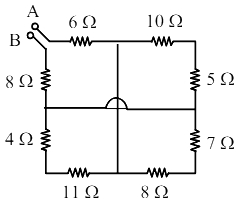
The equivalent resistance between $A$ and $B$ is:
A very long solenoid of radius $R$ is carrying current $I\left( t \right) = kt{e^{ - \alpha t}}\,\left( {k > 0} \right)$ , as a function of time $(t  \geq  0)$. counter clockwise current is taken to be positive. A circular conducting coil of radius $2R$ is placed in the equatorial plane of the solenoid and concentric with the solenoid. The current induced in the outer coil is correctly depicted, as a function of time, by
Out of the following which quantity does not depend on path
The resistance of a wire is $20\, ohms$. It is so stretched that the length becomes three times, then the new resistance of the wire will be ............. $ohms$
A particle of mass $m$ is moving in a circular path of constant radius $r$ such that its centripetal acceleration $a_c$ is varying with time $t$ as, $a_c = k^2rt^2,$ the power delivered to the particle by the forces acting on it is
A particle is dropped on Earth from height $R$ (radius of Earth) and it bounces back to a height $R/2$ the coefficient of restitution for collision is (ignore air resistance and rotation of Earth)
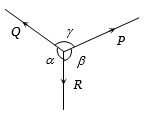
A body is in equilibrium under the action of three coplanar forces $P, Q$ and $R$ as shown in the figure. Select the correct statement