The resistance of a wire is $20\, ohms$. It is so stretched that the length becomes three times, then the new resistance of the wire will be ............. $ohms$
Easy


Download our appand get started for free
Experience the future of education. Simply download our apps or reach out to us for more information. Let's shape the future of learning together!No signup needed.*
Similar Questions
- 1In a potentiometer circuit there is a cell of $e.m.f.$ $2\, volt$, a resistance of $5\, ohm$ and a wire of uniform thickness of length $1000\, cm$ and resistance $15\, ohm$. The potential gradient in the wire isView Solution
- 2Four wires of equal length and of resistances $10$ $ ohms$ each are connected in the form of a square. The equivalent resistance between two opposite corners of the square is ............. $ohm$View Solution
- 3The potential gradient along the length of a uniform wire is $10\,volt/metre$. $B$ and $C$ are the two points at $30\,cm$ and $60\,cm$ point on a meter scale fitted along the wire. The potential difference between $B$ and $C$ will be ............. $volt$View Solution
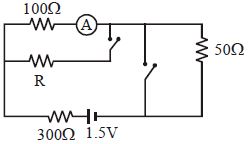
- 4In the circuit shown, the reading of the ammeter (ideal) is the same with both switches open as with both closed find the value of resistance $R$ in $ohm$ . ................ $\Omega$View Solution
- 5For a metallic wire, the ratio $V/i$ ($V = $ the applied potential difference, $i$ = current flowing) isView Solution
- 6If a wire of resistance $20\,\Omega $ is covered with ice and a voltage of $210\, V$ is applied across the wire, then the rate of melting of ice is .................. $g/s$View Solution
- 7View SolutionAccording to Joule's law, if the potential difference across a conductor having a material of specific resistance remains constant, then the heat produced in the conductor is directly proportional to
- 8The series combination of two batteries, both of the same emf $10 \mathrm{\;V},$ but different internal resistance of $20\; \Omega$ and $5\; \Omega,$ is connected to the parallel combination of two resistors $30\; \Omega$ and $\mathrm{R}\; \Omega .$ The voltage difference across the battery of internal resistance $20\; \Omega$ is zero, the value of $\mathrm{R}(\text { in } \Omega)$ isView Solution
- 9When a current of $2\, A$ flows in a battery from negative to positive terminal, the potential difference across it is $12\, V$. If a current of $3\, A$ flowing in the opposite direction produces a potential difference of $15\, V$, the $emf$ of the battery is .............. $V$View Solution
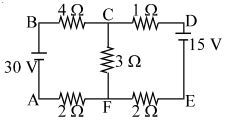
- 10The figure shows a network of five resistances and two batteries The total electrical power consumed by the circuit is ............... $W$View Solution