Question
Eddy currents are induced when

Answer

(a)

Eddy can be created when a conductor is moving through a magnetic field, or when the magnetic field surrounding a stationary conductor is varying.

Need a full question paper?

Generate a complete, print-ready paper with questions like this in minutes — across 16+ boards, with answer keys.
Start Generating Free

Similar questions

For a satellite to orbit around the earth, which of the following must be true ?
If an insulated non-conducting sphere of radius $R$ has charge density $\rho $. The electric field at a distance $r$ from the centre of sphere $(r < R)$ will be
A liquid disturbed by stirring comes to rest after some time due to its property of
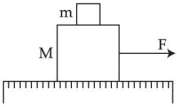
A system of two blocks of masses $m =2 \; kg$ and $M=8 \; kg$ is placed on a smooth table as shown in figure. The coefficient of static friction between two blocks is $0.5$. The maximum horizontal force $F$ that can be applied to the block of mass $M$ so that the blocks move together will be $\dots \; N$
Two long parallel wires whose centres are $a$ distance $d$ apart carry equal currents in opposite directions. If the flux within wires is neglected, the inductance of such arrangement of wire of length $l$ and radius $a$ will be
An electron in an excited state of $Li ^{2+}$ ion has angular momentum $3 h / 2 \pi$. The de Broglie wavelength of the electron in this state is $p \pi a_0$ (where $a_0$ is the Bohr radius). The value of $p$ is
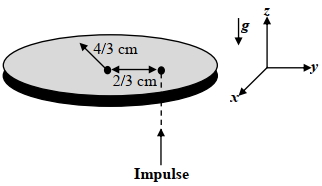
A thin circular coin of mass $5 \mathrm{gm}$ and radius $4 / 3 \mathrm{~cm}$ is initially in a horizontal $x y$-plane. The coin is tossed vertically up ( $+z$ direction) by applying an impulse of $\sqrt{\frac{\pi}{2}} \times 10^{-2} \mathrm{~N}-\mathrm{s}$ at a distance $2 / 3 \mathrm{~cm}$ from its center. The coin spins about its diameter and moves along the $+z$ direction. By the time the coin reaches back to its initial position, it completes $n$ rotations. The value of $n$ is. . . . . [Given: The acceleration due to gravity $\mathrm{g}=10 \mathrm{~ms}^{-2}$ ]
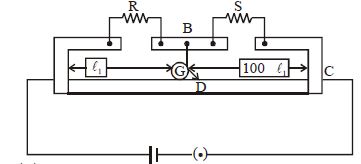
In a meter bridge the point $D$ is neutral point as shown in the figure.
If $r.m.s.$ velocity of a gas is ${V_{rms}} = 1840m/s$ and its density $\rho = 8.99 \times {10^{ - 2}}kg/{m^3},$ the pressure of the gas will be
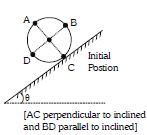
A solid sphere of mass $m$ , radius $R$ is released from rest on sufficient rough long inclined plane of inclination $\theta $ . Consider four points $A$ , $B$ , $C$ and $D$ on the sphere. After one revolution