In a meter bridge the point $D$ is neutral point as shown in the figure.
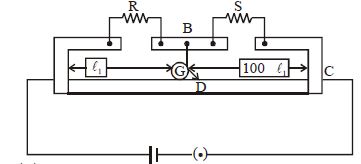
Medium


Download our appand get started for free
Experience the future of education. Simply download our apps or reach out to us for more information. Let's shape the future of learning together!No signup needed.*
Similar Questions
- 1View SolutionThe colour sequence in a carbon resistor is red, brown, orange and silver. The resistance of the resistor is
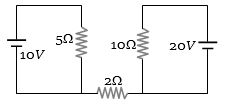
- 2Find out the value of current through $2\,\Omega$ resistance for the given circuit ............ $A$View Solution
- 3The length of a wire of a potentiometer is $100\, cm$, and the $emf$ of its standard cell is $E\,volt$. It is employed to measure the $e.m.f$ of a battery whose internal resistance is $0.5 \,\Omega$. If the balance point is obtained at $l = 30\, cm$ from the positive end, the $e.m.f.$ of the battery isView Solution
where $i$ is the current in the potentiometer
- 4View SolutionIf the length of potentiometer wire is increased, then the length of the previously obtained balance point will
- 5View SolutionIf the length of potentiometer wire is increased, then the length of the previously obtained balance point will
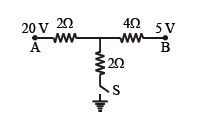
- 6As the switch $S$ is closed in the circuit shown in figure, current passing through it is ................ $\mathrm{A}$View Solution
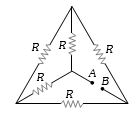
- 7Each of the resistance in the network shown in fig. is equal to $R$. The resistance between the terminals $A$ and $B$ isView Solution
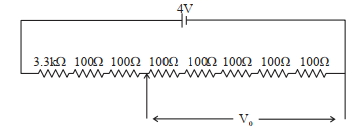
- 8A potential divider circuit is shown in figure. The output voltage $V_0$ isView Solution
- 9Two wires have resistance of $2$ $\Omega$ and $4$ $\Omega$ connected to same voltage, ratio of heat dissipated at resistance isView Solution
- 10One end of a Nichrome wire of length $2\,L$ and cross-sectional area $A$ is attatched to an end of another Nichrome wire of length $L$ and cross-sectional area $2\,A$. If the free end of the longer wire is at an electric potential of $8.0$ $\mathrm{volts}$, and the free end of the shorter wire is at an electric potential of $1.0$ $\mathrm{volt}$, the potential at the junction of the two wires is equal to ............. $V$View Solution