Question

Eels are able to generate current with biological cells called electroplaques. The electroplaques in an eel are arranged in 100 rows, each row stretching horizontally along the body of the fish containing 5000 electroplaques. The arrangement is suggestively shown below. Each electroplaques has an emf of 0.15 V and internal resistance of 0.25 W
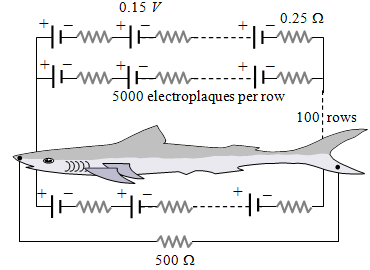
The water surrounding the eel completes a circuit between the head and its tail. If the water surrounding it has a resistance of 500 W, the current an eel can produce in water is about

(a) 1.5 A

(b) 3.0 A

(c) 15 A

(d) 30 A

Answer

(a) 1.5 A

Need a full question paper?

Generate a complete, print-ready paper with questions like this in minutes — across 16+ boards, with answer keys.

Start Generating Free

Similar questions

An object may have:
  1. Varying speed without having varying velocity.
  2. Varying velocity without having varying speed.
  3. Nonzero acceleration without having varying velocity.
  4. Nonzero acceleration without having varying speed.
In which of the following series, does the 121.5nm line of the spectrum of the hydrogen atom lie?
Scientist __________ performed experiment related to photo-electric effect.

A coil having N turns carry a current I as shown in the figure. The magnetic field intensity at point P is

(a)   

(b)

(c)                                           

(d) Zero

The restoring couple in the moving coil galvanometer is due to:

Assertion   :   If three identical bulbs are connected in series as shown in figure then on closing the switches. Bulb C short circuited and hence illumination of bulbs A and B decreases.

Reason      : Voltage on A and B decreases

(a) If both assertion and reason are true and the reason is the correct explanation of the assertion.

(b) If both assertion and reason are true but reason is not the correct explanation of the assertion.

(c) If assertion is true but reason is false.

(d) If the assertion and reason both are false.

Refractive index of air is 1.0003. The correct thickness of air column which will have one more wavelength of yellow light (6000 Å) than in the same thickness in vacuum is

(a) 2 mm

(b) 2 cm

(c) 2 m

(d) 2 km

A charged particle enters in a uniform magnetic field with a certain velocity. The power delivered to the particle by the magnetic field depends on:

Two identical parallel plate capacitors are connected in series to a battery of 100 V. A dielectric slab of dielectric constant 4.0 is inserted between the plates of second capacitor.  The potential difference across the capacitors will now be respectively

(a) 50 V, 50 V

(b) 80 V, 20 V

(c) 20 V, 80 V

(d) 75 V, 25 V

A free neutron decays to a proton but a free proton does not decay to a neutron. This is because:
  1. Neutron is a composite particle made of a proton and an electron whereas proton is a fundamental particle.
  2. Neutron is an uncharged particle whereas proton is a charged particle.
  3. Neutron has large rest mass than the proton.
  4. Weak forces can operate in a neutron but not in a proton.