Questions · Page 1 of 11

M.C.Q (1 Marks)

🎯

Test yourself on this topic

50 questions · timed · auto-graded

Question 11 Mark

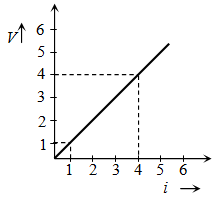
Variation of current and voltage in a conductor has been shown in the diagram below. The resistance of the conductor is
(a) 4 ohm

(b) 2 ohm

(c) 3 ohm 

(d) 1 ohm
Answer

(d) 1 ohm
View full question & answer
Question 21 Mark

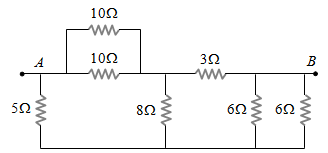
Seven resistances are connected as shown in the figure.  The equivalent resistance between A and B is

(a) 3 W

(b) 4 W

(c) 4.5 W 

(d) 5 W

Answer

(b) 4 W

View full question & answer
Question 31 Mark

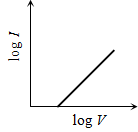
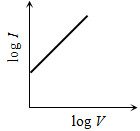
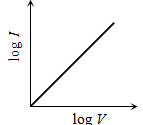
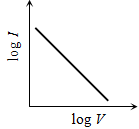
When a current I is passed through a wire of constant resistance, it produces a potential difference V across its ends. The graph drawn between log I and log V will be

(a)

(b)

(c)

(d)

Answer

(a)

View full question & answer
Question 41 Mark

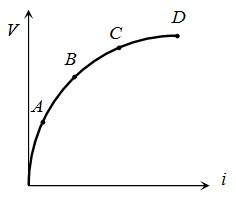
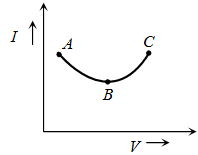
Variation of current passing through a conductor as the voltage applied across its ends as varied is shown in the adjoining diagram. If the resistance (R) is determined at the points A, B, C and D, we will find that

(a) RC = RD

(b) RB > RA

(c) RC > RB

(d) None of these

Answer

(d) None of these

View full question & answer
Question 51 Mark

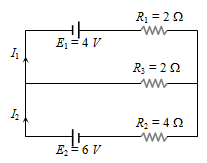
In the circuit shown below E1 = 4.0 V, R1 = 2 W, E2 =  6.0 V, R2 = 4 W and R3 = 2 W.  The current  I1 is

(a) 1.6 A

(b) 1.8 A

(c) 1.25 A   

(d) 1.0 A

Answer

(b) 1.8 A

View full question & answer
Question 61 Mark

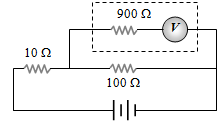
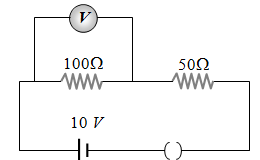
The potential difference across the 100 W resistance in the following circuit is measured by a voltmeter of 900 W resistance. The percentage error made in reading the potential difference is

(a)  

(b) 0.1

(c) 1.0

(d) 10.0

Answer

(c) 1.0

View full question & answer
Question 71 Mark

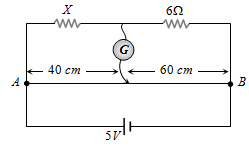
In the circuit shown, a meter bridge is in its balanced state.  The meter bridge wire has a resistance 0.1 ohm/cm.  The value of unknown resistance X and the current drawn from the battery of negligible resistance is

(a) 6 W, 5 amp

(b) 10 W, 0.1 amp

(c) 4 W, 1.0 amp

(d) 12 W, 0.5 amp

Answer

(c) 4 W, 1.0 amp

View full question & answer
Question 81 Mark

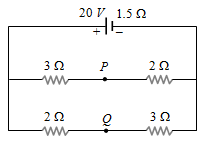
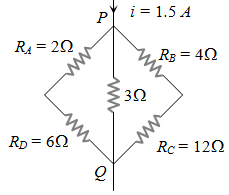
If in the circuit shown below, the internal resistance of the battery is 1.5 W and VP and VQ are the potentials at P and Q respectively, what is the potential difference between the points P and Q

(a)  Zero 

(b) 4 volts (VP > VQ)

(c) 4 volts (VQ > VP)

(d) 2.5 volts (VQ > VP)

Answer

(d) 2.5 volts (VQ > VP)

View full question & answer
Question 91 Mark

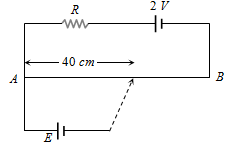
AB is a potentiometer wire of length 100 cm and its resistance is 10 ohms.  It is connected in series with a resistance R = 40 ohms and a battery of e.m.f. 2 V and negligible internal resistance.  If a source of unknown e.m.f. E is balanced by 40 cm length of the potentiometer wire, the value of E is

(a) 0.8 V 

(b) 1.6 V

(c) 0.08 V 

(d) 0.16 V

Answer

(d) 0.16 V

View full question & answer
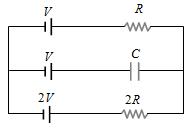
Question 111 Mark

In the given circuit, with steady current, the potential drop across the capacitor must be

(a) V

(b) V / 2

(c) V / 3  

(d) 2V / 3

Answer

(c) V / 3  

View full question & answer
Question 121 Mark

The V-i graph for a conductor makes an angle θ with V-axis. Here V denotes the voltage and i denotes current. The resistance of conductor is given by

(a) sin θ

(b) cos θ

(c) tan θ 

(d) cot θ

Answer

(d) cot θ

View full question & answer
Question 131 Mark

Assertion  :  A person touching a high power line gets stuck with the line.

Reason     : The current carrying wires attract the man towards it.

(a) If both assertion and reason are true and the reason is the correct explanation of the assertion.

(b) If both assertion and reason are true but reason is not the correct explanation of the assertion.

(c) If assertion is true but reason is false.

(d) If the assertion and reason both are false.

Answer

(d) If the assertion and reason both are false.

View full question & answer
Question 141 Mark

Assertion   :  The resistance of super-conductor is zero.

Reason      : The super-conductors are used for the transmission of electric power.

(a) If both assertion and reason are true and the reason is the correct explanation of the assertion.

(b) If both assertion and reason are true but reason is not the correct explanation of the assertion.

(c) If assertion is true but reason is false.

(d) If the assertion and reason both are false.

Answer

(b) If both assertion and reason are true but reason is not the correct explanation of the assertion.

View full question & answer
Question 151 Mark

Assertion :  Electric field outside the conducting wire which carries a constant current is zero.

Reason    : Net charge on conducting wire is zero.

(a) If both assertion and reason are true and the reason is the correct explanation of the assertion.

(b) If both assertion and reason are true but reason is not the correct explanation of the assertion.

(c) If assertion is true but reason is false.

(d) If the assertion and reason both are false.

Answer

(a) If both assertion and reason are true and the reason is the correct explanation of the assertion.

View full question & answer
Question 161 Mark

Assertion :   In meter bridge experiment, a high resistance is always connected in series with a galvanometer.

Reason     : As resistance increases current through the circuit increases.

(a) If both assertion and reason are true and the reason is the correct explanation of the assertion.

(b) If both assertion and reason are true but reason is not the correct explanation of the assertion.

(c) If assertion is true but reason is false.

(d) If the assertion and reason both are false.

Answer

(c) If assertion is true but reason is false.

View full question & answer
Question 171 Mark

Assertion   :   Bending a wire does not effect electrical resistance.

Reason       : Resistance of wire is proportional to resistivity of material.

(a) If both assertion and reason are true and the reason is the correct explanation of the assertion.

(b) If both assertion and reason are true but reason is not the correct explanation of the assertion.

(c) If assertion is true but reason is false.

(d) If the assertion and reason both are false.

Answer

(a) If both assertion and reason are true and the reason is the correct explanation of the assertion.

View full question & answer
Question 181 Mark

Two wires of equal diameters, of resistivities  and   and lengths l1 and l2, respectively, are joined in series.  The equivalent resistivity of the combination is

(a)  

(b)

(c)

(d)

Answer

(a)  

View full question & answer
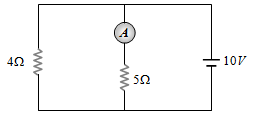
Question 191 Mark

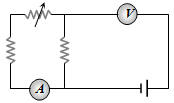
In the circuit, the reading of the ammeter is (assume internal resistance of the battery be zero)

(a)  

(b)  

(c)  

(d) 2 A

Answer

(d) 2 A

View full question & answer
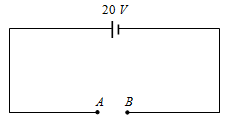
Question 211 Mark

In the shown circuit, what is the potential difference across A and B

(a) 50 V

(b) 45 V

(c) 30 V

(d) 20 V

Answer

(d) 20 V

View full question & answer
Question 221 Mark

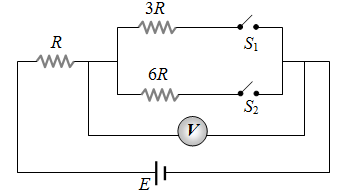
In the circuit shown in figure reading of voltmeter is V1 when only S1 is closed, reading of voltmeter is V2 when only S2 is closed and reading of voltmeter is V3 when both S1 and S2 are closed. Then

(a) V3 > V2 > V1

(b) V2 > V1 > V3

(c) V3 > V1 > V2

(d) V1 > V2 > V3

Answer

(b) V2 > V1 > V3

View full question & answer
Question 231 Mark

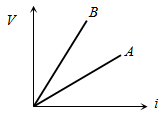
V-i graphs for parallel and series combination of two identical resistors are as shown in figure. Which graph represents parallel combination

(a) A

(b) B

(c) A and B both

(d) Neither A nor B

Answer

(a) A

View full question & answer
Question 241 Mark

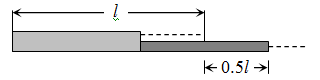
In order to quadruple the resistance of a uniform wire, a part of its length was uniformly stretched till the final length of the entire wire was 1.5 times the original length, the part of the wire was fraction equal to

(a) 1 / 8

(b) 1 / 6

(c) 1 / 10 

(d) 1 / 4

Answer

(a) 1 / 8

View full question & answer
Question 251 Mark

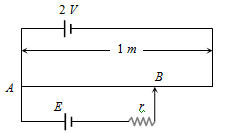
In the given figure, battery E is balanced on 55 cm length of potentiometer wire but when a resistance of 10 W is connected in parallel with the battery then it balances on 50 cm length of the potentiometer wire then internal resistance r of the battery is

(a) 1 W

(b) 3 W

(c) 10 W

(d) 5 W

Answer

(a) 1 W

View full question & answer
Question 261 Mark

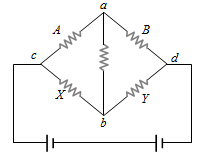
In the Wheatstone's bridge (shown in figure) X = Y and A > B. The direction of the current between ab will be

(a) From a to b

(b) From b to a

(c) From b to a through c

(d) From a to b through c

Answer

(b) From b to a

View full question & answer
Question 271 Mark

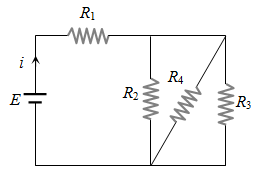
In the circuit given E = 6.0 V, R1 = 100 ohms, R2 = R3 = 50 ohms, R4 = 75 ohms. The equivalent resistance of the circuit, in ohms, is

(a) 11.875

(b) 26.31

(c) 118.75

(d) None of these

Answer

(c) 118.75

View full question & answer
Question 281 Mark

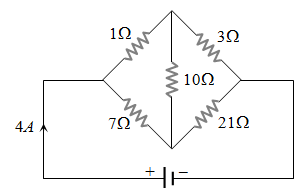
In the circuit shown in figure, the current drawn from the battery is 4A.  If 10 W resistor is replaced by 20 W resistor, then current drawn from the circuit will be

(a) 1 A

(b) 2 A

(c) 3 A

(d) 0 A

Answer

(d) 0 A

View full question & answer
Question 291 Mark

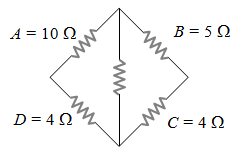
In a typical Wheatstone network, the resistances in cyclic order are A = 10 W, B = 5 W, C = 4 W and D = 4 W for the bridge to be balanced

(a) 10 W should be connected in parallel with A

(b) 10 W should be connected in series with A

(c) 5 W should be connected in series with B

(d) 5 W should be connected in parallel with B

Answer

(a) 10 W should be connected in parallel with A

View full question & answer
Question 301 Mark

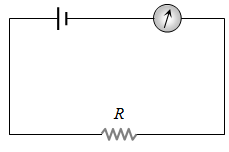
A battery of emf 10 V and internal resistance 3Ω is connected to a resistor as shown in the figure.  If the current in the circuit is 0.5 A.  then the resistance of the resistor will be

(a) 19 W  

(b) 17 W

(c) 10 W  

(d) 12 W

Answer

(b) 17 W

View full question & answer
Question 311 Mark

In the figure, current through the 3 Ω  resistor is 0.8 ampere, then potential drop through 4 Ω  resistor is

(a) 9.6 V

(b) 2.6 V

(c) 4.8 V  

(d) 1.2 V

Answer

(c) 4.8 V  

View full question & answer
Question 321 Mark

In the circuit shown in the figure, the current through

(a) The 3 W resistor is 0.50A

(b) The 3 W resistor is 0.25 A

(c) The 4 W resistor is 0.50A

(d) The 4 W resistor is 0.25 A

Answer

(d) The 4 W resistor is 0.25 A

View full question & answer
Question 331 Mark

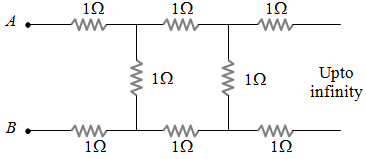
The resistance between the terminal points  A and B of the given infinitely long circuit will be

(a) ( 

(b) (1 -  

(c) (1 +  

(d) (2 +  

Answer
(c) (1 +  
View full question & answer
Question 341 Mark

The resistance of a coil is 4.2 Ω at 100 oC and the temperature coefficient of resistance of its material is 0.004/o C.  Its resistance at 0o C is

(a) 6.5 Ω

(b) 5 Ω

(c) 3 Ω

(d) 4 Ω

Answer

(c) 3 Ω

View full question & answer
Question 351 Mark

Potential difference between the points P and Q in the electric circuit shown is

(a) 4.5 V

(b) 1.2 V

(c) 2.4 V  

(d) 2.88 V

Answer

(d) 2.88 V

View full question & answer
Question 361 Mark

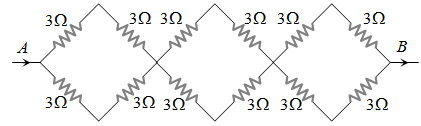
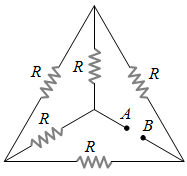
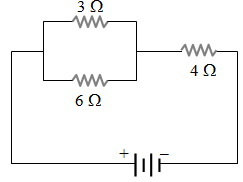
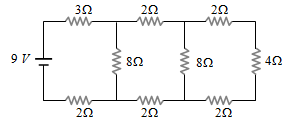
In the network of resistors shown in the adjoining figure, the equivalent resistance between A and B is

(a) 54 ohm
(b) 18 ohm
(c) 36 ohm
(d) 9 ohm

Answer

(d) 9 ohm

View full question & answer
Question 371 Mark

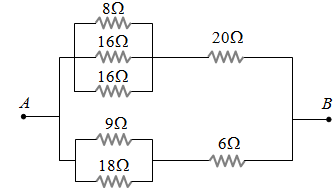
The equivalent resistance of the arrangement of resistances shown in adjoining figure between the points A and B is

(a) 6 ohm

(b) 8 ohm

(c) 16 ohm

(d) 24 ohm

Answer

(b) 8 ohm

View full question & answer
Question 381 Mark

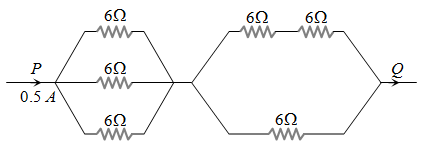
Resistances of 6 ohm each are connected in the manner shown in adjoining figure. With the current 0.5 ampere as shown in figure, the potential difference  is

(a) 3.6 V

(b) 6.0 V

(c) 3.0 V

(d) 7.2 V

Answer

(c) 3.0 V

View full question & answer
Question 391 Mark

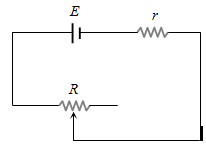
A battery of e.m.f. E and internal resistance r is connected to a variable resistor R as shown here. Which one of the following is true

(a) Potential difference across the terminals of the battery is maximum when R = r

(b) Power delivered to the resistor is maximum when R = r

(c) Current in the circuit is maximum when R = r

(d) Current in the circuit is maximum when R >> r

Answer

(b) Power delivered to the resistor is maximum when R = r

View full question & answer
Question 401 Mark

If each of the resistance of the network shown in the figure is R, the equivalent resistance between A and B is

(a) 5 R

(b) 3 R

(c) R 

(d) R/2

Answer

(c) R 

View full question & answer
Question 411 Mark

Two resistance wires on joining in parallel the resultant resistance is .  One of the wire breaks, the effective resistance is 2 ohms.  The resistance of the broken wire is

(a)  

(b) 2 ohm

(c)

(d) 3 ohm

Answer

(d) 3 ohm

View full question & answer
Question 421 Mark

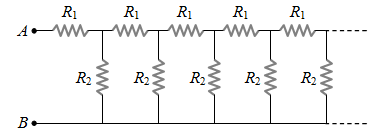
An infinite sequence of resistance is shown in the figure. The resultant resistance between A and B will be, when   and

(a) Infinity

(b) 1 Ω

(c) 2 Ω

(d) 1.5 Ω

Answer

(c) 2 Ω

View full question & answer
Question 431 Mark

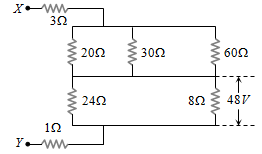
The potential difference across 8 ohm resistance is 48 volt as shown in the figure. The value of potential difference across X and Y points will be

(a) 160 volt

(b) 128 volt

(c) 80 volt

(d) 62 volt

Answer

(a) 160 volt

View full question & answer
Question 451 Mark

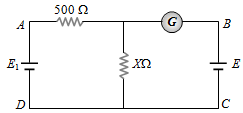
In the adjoining circuit, the battery  has an e.m.f of 12 volt and zero internal resistance while the battery E has an e.m.f  of 2 volt. If the galvanometer G reads zero, then the value of the resistance X in ohm is

(a) 10

(b) 100

(c) 500

(d) 200

Answer

(b) 100

View full question & answer
Question 471 Mark

In the given circuit, the voltmeter records 5 volts. The resistance of the voltmeter in ohms is

(a) 200

(b) 100

(c) 10       

(d) 50

Answer

(b) 100

View full question & answer
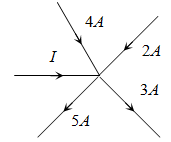
Question 481 Mark

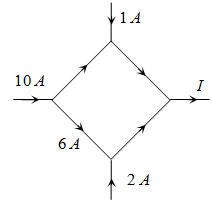
The figure shows a network of currents. The magnitude of currents is shown here. The current I will be

(a) 3 A

(b) 9 A

(c) 13 A

(d) 19 A

Answer

(c) 13 A

View full question & answer
Question 491 Mark

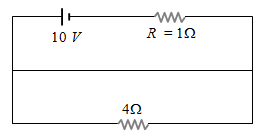
Potential difference across the terminals of the battery shown in figure is (r = internal resistance of battery)

(a) 8 V

(b) 10 V

(c) 6 V

(d) Zero

Answer

(d) Zero

View full question & answer
Question 501 Mark

A moving coil galvanometer of resistance 100 is used as an ammeter using a resistance 0.1 The maximum deflection current in the galvanometer is 100A. Find the minimum current in the circuit so that the ammeter shows maximum deflection

(a) 100.1 mA

(b) 1000.1 mA

(c) 10.01 mA

(d) 1.01 mA

Answer

(a) 100.1 mA

View full question & answer
M.C.Q (1 Marks) - Physics STD 12 Science Questions - Vidyadip