MCQ
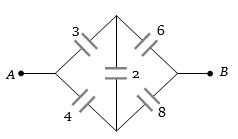
Effective capacitance between $A$ and $B$ in the figure shown is (all capacitance are in $\mu F$)
  • A
    $21\,\mu F$
  • B
    $23\,\mu F$
  • C
    $\frac{3}{{14}}\mu F$
  • $\frac{{14}}{3}\,\mu F$

Answer

Correct option: D.
$\frac{{14}}{3}\,\mu F$
d
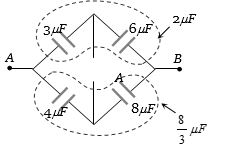
(d) Given circuit is balanced Whetstone bridge. So capacitor of $2\ \mu F$ can be dropped from the circuit
${C_{AB}} = 2 + \frac{8}{3} = \frac{{14}}{3}\,\mu F$

Need a full question paper?

Generate a complete, print-ready paper with questions like this in minutes — across 16+ boards, with answer keys.
Start Generating Free

Similar questions

For a specific wavelength $670 \; nm$ of light coming from a galaxy moving with velocity $v$, the observed wavelength is $670.7 \; nm$. The value of $v$ is ............
Mass of moon is $7.34 \times {10^{22}}\,kg$. If the acceleration due to gravity on the moon is $1.4\,m/{s^2}$, the radius of the moon is $(G = 6.667 \times {10^{ - 11}}\,N{m^2}/k{g^2})$
An ideal monoatomic gas expands to twice its volume. If the process is isothermal, the magnitude of work done by the gas is $W_i$. If the process is adiabatic, the magnitude of work done by the gas is $W_a$. Which of the following is true?
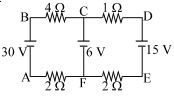
The figure shows a network of four resistances and three batteries Mark the incorrect statement.
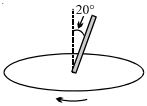
$A$ uniform rod is fixed to a rotating turntable so that its lower end is on the axis of the turntable and it makes an angle of $20^o$ to the vertical. (The rod is thus rotating with uniform angular velocity about a vertical axis passing through one end.) If the turntable is rotating clockwise as seen from above. Is there a torque acting on it, and if so in what direction?
A stone thrown upward with a speed $u$ from the top of the tower reaches the ground with a velocity $3u$. The height of the tower is
The escape speed of an electron launched from the surface of a glass sphere of diameter $1\ cm$ that has been charged to $10\ nC$ is $x \times 10^7\ m/sec$ . The value of $x$ is 
Moment of inertia of a sphere of mass $M$ and radius $R$ is $I.$ Keeping $M$ constant if a graph is plotted between $I $ and $R,$ then its form would be
An inductive circuit contains a resistance of $10 \,ohm$ and an inductance of $2.0\, henry$. If an ac voltage of $120 \,volt$ and frequency of $60\, Hz$ is applied to this circuit, the current in the circuit would be nearly......$amp$
Two charged particles traverse identical helical paths in a completely opposite sense in a uniform magnetic field $B = B_0 \hat k$ .