MCQ
Efficiency $(\eta)$ of the heat engine in thermodynamics can be defined as:
  • A
    $\eta=\frac{\text{W}}{\text{Q}_2}$
  • B
    $\eta=1-\frac{\text{Q}_1}{\text{Q}_2}$
  • $\eta=\frac{\text{W}}{\text{Q}_1}$
  • D
    None of these.

Answer

Correct option: C.
$\eta=\frac{\text{W}}{\text{Q}_1}$
For heat engine, $Q_1 = W + Q_2$
$\Rightarrow W = Q_1 - Q_2$
$Q_2$ is heat rejected to the environment.
So, $\eta=\frac{\text{Q}_1-\text{Q}_2}{\text{Q}_1}=\frac{\text{W}}{\text{Q}_1}$

Need a full question paper?

Generate a complete, print-ready paper with questions like this in minutes — across 16+ boards, with answer keys.
Start Generating Free

Similar questions

$A$ hollow sphere of radius $R$ and mass $m$ is fully filled with water of mass $m$. It is rolled down a horizontal plane such that its centre of mass moves with a velocity $v$. If it purely rolls
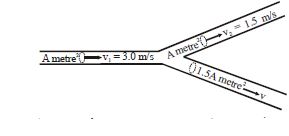
An incompressible liquid flows through a horizontal tube as shown in the figure. Then, the velocity $v$ of the fluid is ......... $m/s$
A reversible engine has an efficiency of $\frac{1}{4}$. If the temperature of the sink is reduced by $58^{\circ} {C}$, its efficiency becomes double. Calculate the temperature of the sink. (In $^{\circ} {C}$)
In a sinusoidal wave, the time required for a particular point to move from maximum displacement to zero displacement is $0.17s.$ The frequency of the wave is:
In one dimensional motion, instantaneous speed $v$ satisfies $0\le\text{v}<\text{v}_0.$
The thickness of a metallic plate is $0.4 cm$ . The temperature between its two surfaces is ${20^o}C$. The quantity of heat flowing per second is $50$ calories from $5c{m^2}$ area. In $CGS$ system, the coefficient of thermal conductivity will be
The three states of matter depend on:
A body $A$ of mass $M$ while falling vertically downwards under gravity breaks into two parts; a body $B$ of mass $\frac{2}{3} M$. The centre of mass of bodies $B$ and $C$ taken together shifts compared to that of body $A$ towards
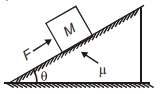
A block (mass $=M kg$ ) is placed on a rough inclined plane. A force $F$ is applied parallel to the inclined (as shown in figure) such that it just starts moving upward. The value of $F$ is
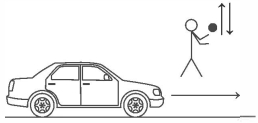
A boy standing on the footpath tosses a ball straight up and catches it. The driver of a car passing by moving with uniform velocity sees this.The trajectory of the ball as seen by the driver will be