Eight equal drops of water are falling through air with a steady speed of $10\,cm / s$. If the drops coalesce, the new velocity is $.........\,cm/s$
JEE MAIN 2023, Diffcult


Download our appand get started for free
Experience the future of education. Simply download our apps or reach out to us for more information. Let's shape the future of learning together!No signup needed.*
Similar Questions
- 1A hydraulic automobile lift is designed to lift cars with a maximum mass of $3000\; kg$. The area of cross-section of the piston carrying the load is $425 \;cm ^{2} .$ What maximum pressure would the smaller piston have to bear?View Solution
- 2The two thigh bones (femures), each of cross-sectional area $10 \,cm ^2$ support the upper part of a person of mass $50 \,kg$. The average pressure sustained by the femures is ............. $N / m ^2$View Solution
- 3View SolutionA liquid is flowing in a horizontal pipe of non-uniform cross section. Which of the following quantities may remain unchanged with respect to time?
- 4View SolutionA tank filled with fresh water has a hole in its bottom and water is flowing out of it. If the size of the hole is increased, then
- 5Water is flowing through a tube of non-uniform cross-section ratio of the radius at entry and exit end of the pipe is $ 3 : 2.$ Then the ratio of velocities at entry and exit of liquid isView Solution
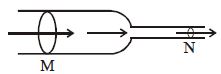
- 6Horizontal tube of non-uniform cross-section has radii of $0.1\,m$ and $0.05\,m$ respectively at $M$ and $N.$ For a stream-line flow of liquid the rate of liquid flow isView Solution
- 7A vessel of area of cross-section A has liquid to a height $H$ . There is a hole at the bottom of vessel having area of cross-section a. The time taken to decrease the level from ${H_1}$ to ${H_2}$ will beView Solution
- 8A uniform solid cylinder of density $0.8$ $g/cm^3$ floats in equilibrium in a combination of two non-mixing liquid $A$ and $B$ with its axis vertical. The densities of liquid $A$ and $B$ are $0.7$ $g/cm^3$ and $1.2$ $gm/cm^3$. The height of liquid $A$ is $h_A = 1.2$ $cm$ and the length of the part of cylinder immersed in liquid $B$ is $h_B = 0.8$ $cm$. Then the length part of the cylinder in air is ....... $cm$View Solution
- 9View SolutionIn Poiseuilli's method of determination of coefficient of viscosity, the physical quantity that requires greater accuracy in measurement is
- 10$Assertion :$ A bubble comes from the bottom of a lake to the top.View Solution
$Reason :$ Its radius increases.