Water is flowing through a tube of non-uniform cross-section ratio of the radius at entry and exit end of the pipe is $ 3 : 2.$ Then the ratio of velocities at entry and exit of liquid is
Medium


Download our appand get started for free
Experience the future of education. Simply download our apps or reach out to us for more information. Let's shape the future of learning together!No signup needed.*
Similar Questions
- 1A small ball of mass $m$ and density $\rho$ is dropped in a viscous liquid of density $\rho_0$. After sometime, the ball falls with constant velocity. The viscous force on the ball is:View Solution
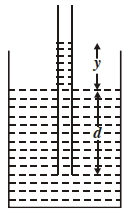
- 2A drinking straw is dipped in a pan of water to depth d from the surface (see figure below). Now water is sucked into it up to an initial height $h_0$ and then left to oscillate. As a result, its height $y$ from the surface of the water varies periodically. Ignoring damping, the equation for $y$ is ( $g$ is the acceleration due to gravity):View Solution
- 3Water falls down a $500.0 \,m$ shaft to reach a turbine which generates electricity. ................ $m^3$ water must fall per second in order to generate $1.00 \times 10^9 \,W$ of power ? (Assume $50 \%$ efficiency of conversion and $\left.g=10 \,ms ^{-2}\right)$View Solution
- 4Two liquids of densities $d_1$ and $d_2$ are flowing in identical capillary tubes uder the same pressure difference. Ift $t_1$ and $t_2$ are time taken for the flow of equal quantities (mass) of liquids, then the ratio of coefficient of viscosity of liquids must beView Solution
- 5At shallow depth $h$, the pressure in the ocean is simply given by $P = P_0 + \rho gh$, in which $\rho$ is the density of water and $P_0$ is the air pressure. As we go deeper, the high pressure causes the water to compress and become denser. Which of the following sketches illustrates the correct dependence of the pressure on the depth $h$ ?View Solution
- 6A metallic block of density $5\,gm \,cm^{-3}$ and having dimensions $5 cm × 5 cm × 5 cm$ is weighed in water. Its apparent weight will beView Solution
- 7A container of height $10\, cm$ is filled with water. There is a hole at bottom. Find the pressure difference between points at top and bottom.View Solution
- 8View SolutionConstruction of submarines is based on
- 9Two different liquids are flowing in two tubes of equal radius. The ratio of coefficients of viscosity of liquids is $52:49$ and the ratio of their densities is $13:1$, then the ratio of their critical velocities will beView Solution
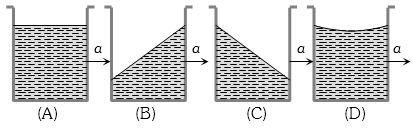
- 10View SolutionA vessel containing water is given a constant acceleration a towards the right, along a straight horizontal path. Which of the following diagram represents the surface of the liquid