Eight small drops, each of radius $r$ and having same charge $q$ are combined to form a big drop. The ratio between the potentials of the bigger drop and the smaller drop is
Medium


Download our appand get started for free
Experience the future of education. Simply download our apps or reach out to us for more information. Let's shape the future of learning together!No signup needed.*
Similar Questions
- 1Given below are two statements: one is labelled as Assertion $A$ and the other is labelled as Reason $R$.View Solution
Assertion $A$: The potential ( $V$ ) at any axial point, at $2 \mathrm{~m}$ distance ( $r$ ) from the centre of the dipole of dipole moment vector $\vec{P}$ of magnitude, $4 \times 10^{-6} \mathrm{C} \mathrm{m}$, is $\pm 9 \times 10^3 \mathrm{~V}$.
(Take $\frac{1}{4 \pi \epsilon_0}=9 \times 10^9 \mathrm{Sl}$ units)
Reason $R$: $V= \pm \frac{2 P}{4 \pi \epsilon_0 r^2}$, where $r$ is the distance of any axial point, situated at $2 \mathrm{~m}$ from the centre of the dipole.
In the light of the above statements, choose the correct answer from the options given below:
- 2There is a uniform spherically symmetric surface charge density at a distance $R_0$ from the origin. The charge distribution is initially at rest and starts expanding because of mutual repulsion. The figure that represents best the speed $V(R(t))$ of the distribution as a function of its instantaneous radius $R(t)$ isView Solution
- 3The capacitance of a parallel plate capacitor is $C$ when the region between the plate has air. This region is now filled with a dielectric slab of dielectric constant $k$. The capacitor is connected to a cell of $emf$ $E$, and the slab is taken outView Solution
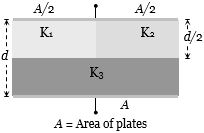
- 4A parallel plate capacitor of area $A$, plate separation $d$ and capacitance $C$ is filled with three different dielectric materials having dielectric constants ${k_1},{k_2}$ and ${k_3}$ as shown. If a single dielectric material is to be used to have the same capacitance $C$ in this capacitor, then its dielectric constant $k$ is given byView Solution
- 5A negatively charged plate has charge density of $2 \times {10^{ - 6}}\,C/{m^2}$. The initial distance of an electron which is moving toward plate, cannot strike the plate, if it is having energy of $200\,eV$View Solution
- 6A capacitor when filled with a dielectric $K = 3$ has charge ${Q_0}$, voltage ${V_0}$ and field ${E_0}$. If the dielectric is replaced with another one having $K = 9$ the new values of charge, voltage and field will be respectivelyView Solution
- 7In a region, electric field varies as $E = 2x^2 -4$ where $x$ is the distance in metre from origin along $x-$ axis. A positive charge of $1\,\mu C$ is released with minimum velocity from infinity for crossing the origin, thenView Solution
- 8A parallel plate capacitor having a plate separation of $2\, mm$ is charged by connecting it to a $300\, V$ supply. The energy density is.....$J/m^3$View Solution
- 9Which of the following statement$(s)$ is/are correct?View Solution
$(A)$ If the electric field due to a point charge varies as $r^{-25}$ instead of $r^{-2}$, then the Gauss law will still be valid.
$(B)$ The Gauss law can be used to calculate the field distribution around an electric dipole.
$(C)$ If the electric field between two point charges is zero somewhere, then the sign of the two charges is the same.
$(D)$ The work done by the external force in moving a unit positive charge from point $A$ at potential $V_A$ to point $B$ at potential $V_B$ is $\left(V_B-V_A\right)$.
- 10The electric potential $V(x)$ in a region around the origin is given by $V(x) = 4x^2\,volts$ . The electric charge enclosed in a cube of $1\,m$ side with its centre at the origin is (in coulomb)View Solution