The electric potential $V(x)$ in a region around the origin is given by $V(x) = 4x^2\,volts$ . The electric charge enclosed in a cube of $1\,m$ side with its centre at the origin is (in coulomb)
AIEEE 2012, Medium


Download our appand get started for free
Experience the future of education. Simply download our apps or reach out to us for more information. Let's shape the future of learning together!No signup needed.*
Similar Questions
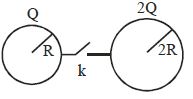
- 1Two spheres of radius $R$ and $2R$ having charge $Q$ and $2Q$ respectively are placed far away from each other. How much charge will flow when key $'k'$ is pressed ?View Solution
- 2A capacitor of capacitance $900\,\mu F$ is charged by a $100\,V$ battery. The capacitor is disconnected from the battery and connected to another uncharged identical capacitor such that one plate of uncharged capacitor connected to positive plate and another plate of uncharged capacitor connected to negative plate of the charged capacitor. The loss of energy in this process is measured as $x \times 10^{-2}\,J$. The value of $x$ is $..............$View Solution
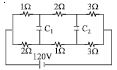
- 3In the circuit shown in figure $C_1 = C_2 = 2$ $\mu F$. Then charge stored inView Solution
- 4The material filled between the plates of a parallel plate capacitor has resistivity $200 \Omega \, {m}$. The value of capacitance of the capacitor is $2\, {pF}$. If a potential difference of $40 \,{V}$ is applied across the plates of the capacitor, then the value of leakage current flowing out of the capacitor isView Solution
(given the value of relative permitivity of material is $50$ )
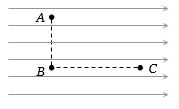
- 5Figure shows three points $A$, $B$ and $C$ in a region of uniform electric field $\overrightarrow E $. The line $AB$ is perpendicular and $BC$ is parallel to the field lines. Then which of the following holds good. Where ${V_A} > {V_B}$ and ${V_C}$ represent the electric potential at points $A$, $B$ and $C$ respectivelyView Solution
- 6Two identical particles of mass $m$ and charge $q$ are shot at each other from a very great distance with an initial speed $v$. The distance of closest approach of these charges isView Solution
- 7How will the voltage $(V)$ between the two plates of a parallel plate capacitor depend on the distance $(d)$ between the plates, if the charge on the capacitor remains the same?View Solution
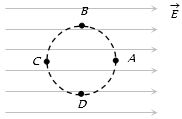
- 8The electric field in a region surrounding the origin is uniform and along the $x$ - axis. A small circle is drawn with the centre at the origin cutting the axes at points $A, B, C, D$ having co-ordinates $(a, 0), (0, a), (-a, 0), (0, -a)$; respectively as shown in figure then potential in minimum at the pointView Solution
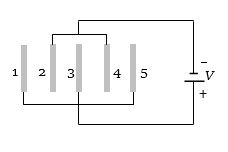
- 9Five identical plates each of area $A$ are joined as shown in the figure. The distance between the plates is $d$. The plates are connected to a potential difference of $V\;volts$. The charge on plates $1$ and $4$ will beView Solution
- 10Two identical parallel plate capacitors are connected in series to a battery of $100\,V$. A dielectric slab of dielectric constant $4.0$ is inserted between the plates of second capacitor. The potential difference across the capacitors will now be respectivelyView Solution