MCQ
Eight spherical rain drops of the same mass and radius are falling down with a terminal speed of $6\, cm -s^{-1}$ . If they coalesce to form one big drop, what will be the terminal speed of the bigger drop ? (Neglect the buoyancy of the air) ....... $cm -s^{-1}$
  • A
    $1.5$
  • B
    $6$
  • $24$
  • D
    $32$

Answer

Correct option: C.
$24$
c
$\mathrm{R}=\mathrm{n}^{1 / 3} \mathrm{r}=8^{1 / 3} \mathrm{r}=2 \mathrm{r}$

$\frac{V_{T_{1}}}{V_{T_{2}}}=\left(\frac{R_{1}}{R_{2}}\right)^{2}$

$\mathrm{V}_{\mathrm{T}_{2}}=6 \times 4$

$\mathrm{V}_{\mathrm{T}_{2}}=24 \mathrm{cm} / \mathrm{s}$

Need a full question paper?

Generate a complete, print-ready paper with questions like this in minutes — across 16+ boards, with answer keys.

Start Generating Free

Similar questions

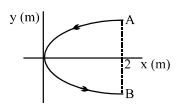
A conducting wire bent in the form of a parabola $y^2 = 2x$ carries a current $i = 2 A$ as shown in figure. This wire is placed in a uniform magnetic field $\vec B =  - 4\,\hat k$ $Tesla$. The magnetic force on the wire is (in newton)
Two particles $A$ and $B$ are projected simultaneously from a fixed point of the ground. Particle $A$ is projected on a smooth horizontal surface with speed $v$, while particle $B$ is projected in air with speed $\frac{2 v}{\sqrt{3}}$. If particle $B$ hits the particle $A$, the angle of projection of $B$ with the vertical is
A projectile is thrown with speed $40 \,ms ^{-1}$ at angle $\theta$ from horizontal. It is found that projectile is at same height at $1 \,s$ and $3 \,s$. What is the angle of projection?
Two particles $\mathrm{X}$ and $\mathrm{Y}$ having equal charges are being accelerated through the same potential difference. Thereafter they enter normally in a region of uniform magnetic field and describes circular paths of radii $R_1$ and $R_2$ respectively. The mass ratio of $\mathrm{X}$ and $\mathrm{Y}$ is :
In an experiment to measure focal length $(f)$ of convex lens, the least counts of the measuring scales for the position of object $(u)$ and for the position of image $(v)$ are $\Delta u$ and $\Delta v$, respectively. The error in the measurement of the focal length of the convex lens will be :
A metal rod of $1\; m$ length, is dropped exact vertically on to a hard metal floor. With an oscilloscope, it is determined that the impact produces a longitudinal wave of $1.2 \;k Hz$ frequency. The speed of sound in the metal rod is
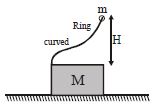
A ring of mass $m$ can freely slide along the massless curved rod as shown. At the lower most point, the curved path becomes vertical. If whole system is released from rest, velocity of ring $(v) $ at lowermost point just before touching the block $M$ (all surfaces are smooth) is
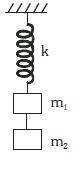
Two masses $m_1$ and $m_2$ are supended together by a massless spring of constant $k$. When the masses are in equilibrium, $m_1$ is removed without disturbing the system; the amplitude of vibration is
When current in a coil changes from $5\,A$ to $2\,A$ in $0 .1\,s,$ average voltage of $50\,V$ is produced. The self- inductance of the coil is.......$H$
A particle executing a simple harmonic motion of period $2\ s$ . When it is at its extreme displacement from its mean position, it receives an additional energy equal to what it had in its mean position. Due to this , in its subsequent motion,