Question
Einstein's theory of relativity is based on:

Answer

  1. The velocity of light is the same for all observers
Explanation:
The main postulate of Einstein's special theory of relativity is that the speed of light is constant and equal to c in all the inertial frames i.e the velocity of light is same for all observers. 

Need a full question paper?

Generate a complete, print-ready paper with questions like this in minutes — across 16+ boards, with answer keys.
Start Generating Free

Similar questions

An electric dipole placed in a uniform elecrtric field exepriences:
Powers of two lenses kept in contact, are $P_{1}$ and $P_{2}.$ The power of equivalent lens will be :
In a semiconductor(a) There are no free electrons at any temperature(b) The number of free electrons is more than that in a conductor(c) There are no free electrons at 0 K(d) None of these


The Balmer series for the $H-$ atom can be observed:
Examples of inorganic semiconductors is:
The diffraction effect can be observed in(a) Only sound waves(b) Only light waves(c) Only ultrasonic waves (d) Sound as well as light waves
   
   
A silicon speciman is made into a $P-$type semi-conductor by dopping, on an average, one Indium atom per $5 \times 10^7$ silicon atoms. If the number density of atoms in the silicon specimen is $5 \times 10^{28}$ atoms $/ \mathrm{m}^3$ then the number of acceptor atoms in silicon per cubic centimetre will be
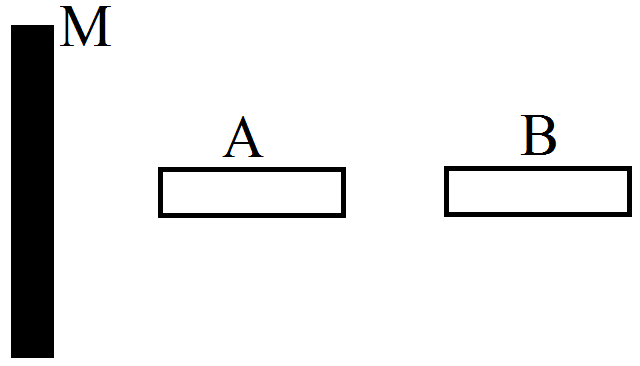
A large nonconducting sheet M is given a uniform charge density. Two uncharged small metal rods A and B are placed near the sheet as shown in figure:
  1. M attracts A.
  2. M attracts B.
  3. A attracts B.
  4. B attracts A.
The branch of physics which deals with the study of forces, Fields and potential arising from static charges is called as:
If two streams of protons move parallel to each other in the same direction, then they(a) Do not exert any force on each other(b) Repel each other(c) Attract each other(d) Get rotated to be perpendicular to each other