MCQ
Elastic limit is equal to:
  • A
    Young's modulus.
  • B
    Modulus of rigidity.
  • C
    Stress.
  • D
    Strain.

Answer

  1. Stress.

Need a full question paper?

Generate a complete, print-ready paper with questions like this in minutes — across 16+ boards, with answer keys.
Start Generating Free

Similar questions

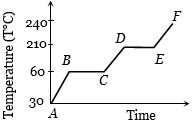
A solid substance is at $30°C$. To this substance heat energy is supplied at a constant rate. Then temperature versus time graph is as shown in the figure. The substance is in liquid state for the portion (of the graph)
A ball of radius $11\ cm$ and mass $8\ kg$ rolls from rest down a ramp of length $2\ m$. The ramp is inclined at ${35^o}$ to the horizontal. When the ball reaches the bottom, its velocity is .......... $m/s$.  $(sin\ 35^o  = 0.57)$
A mass $m$ attached to free end of a spring executes SHM with a period of $1\; s$. If the mass is increased by $3\; kg$ the period of oscillation increases by one second, the value of mass $m$ is $..............kg$.
A block of mass M is pulled along a horizontal frictionless surface by a rope of mass m. Force P is applied at one end of the rope. The force which the rope exerts on the block is:
A ball of mass $2\,kg$ and another of mass $4\,kg$ are dropped together from a $60$ feet tall building. After a fall of $30$ feet each towards earth, their respective kinetic energies will be in the ratio of
$A$ block of mass $m$ slides down a plane inclined at an angle $\theta$ . Which of the following will $NOT$ increase the energy lost by the block due to friction?
If the gravitational potential energy at infinity is assumed to be zero, the potential energy at distance (Re + h) from the centre of the earth:
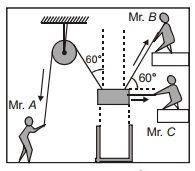
Mr. $A, B$ and $C$ are trying to put a heavy piston into a cylinder at a mechanical workshop in railway yard. If they apply forces $F_1, F_2$ and $F_3$ respectively on ropes then for which set of forces at that instant, they will be able to perform the said job?
At what depth below the surface of the earth, acceleration due to gravity $g$ will be half its value $1600 \,km$ above the surface of the earth
In thermodynamics, heat and work are