MCQ
Elasticity of a material can be altered by:
  • A
    Annealing.
  • B
    Hammering.
  • C
    Adding impurities.
  • D
    All of the above.

Answer

  1. All of the above.

Need a full question paper?

Generate a complete, print-ready paper with questions like this in minutes — across 16+ boards, with answer keys.

Start Generating Free

Similar questions

By what factor the $r.m.s.$ velocity will change, if the temperature is raised from $27^\circ C$ to  $327^\circ C$
A ball of mass $0.5\, kg$ moving with a velocity of $2\, m/sec$ strikes a wall normally and bounces back with the same speed. If the time of contact between the ball and the wall is one millisecond, the average force exerted by the wall on the ball is ........ $newton$
The pressure of an ideal gas varies with volume as $P = \alpha V,$ where $\alpha $ is a constant. One mole of the gas is allowed to undergo expansion such that its volume becomes $'m'$  times its initial volume. The work done by the gas in the process is
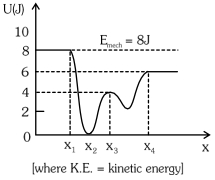
Given below is the plot of a potential energy function $U(x)$ for a system, in which a particle is in one dimensional motion, while a conservative force $F(x)$ acts on it. Suppose that $E_{\text {mech }}=8\, {J}$, the incorrect statement for this system is:
A disc and a sphere of same radius but different masses roll off on two inclined planes of the same altitude and length. Which one of the two objects gets to the bottom of the plane first ?
A trolley of mass $m_1$ is placed on horizontal rigid pair of rails at same height. A mass $m_2$ is suspended to the trolley vertically by me ans of a ideal massless rope. The rope hangs between rails without touching them. Trolley can move along smooth rails but can't move in any other direction. Suspended mass is given small oscillation and perform $SHM$ after displacing small from stable equilibrium position in two ways, first perpendicular to the rails and second parallel to the rails. The ratio of time period of these (second case to first case) two $SHM's$ is
The force constant of a weightless spring is $16 \,N/m$. A body of mass $1.0\, kg$ suspended from it is pulled down through $5\, cm$ and then released. The maximum kinetic energy of the system (spring + body) will be
A body of mass $10\,kg$ moving with speed of $3 \,ms ^{-1}$ collides with another stationary body of mass $5 \,kg$. As a result, the two bodies stick together. The $KE$ of composite mass will be .......... $J$
When a body slides down from rest along a smooth inclined plane making an angle of $30^{\circ}$ with the horizontal, it takes time $T$. When the same body slides down from the rest along a rough inclined plane making the same angle and through the same distance, it takes time $\alpha {T}$, where $\alpha$ is a constant greater than $1 .$ The co-efficient of friction between the body and the rough plane is $\frac{1}{\sqrt{{x}}}\left(\frac{\alpha^{2}-1}{\alpha^{2}}\right)$ where ${x}=..... .$
If the density of oxygen is $16$ times that of hydrogen, what will be the ratio of their corresponding velocities of sound waves