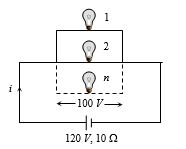
Electric bulb $50\, W$ - $100\, V$ glowing at full power are to be used in parallel with battery $120\, V$, $10 \,\Omega$. Maximum number of bulbs that can be connected so that they glow in full power is
Diffcult


Download our appand get started for free
Experience the future of education. Simply download our apps or reach out to us for more information. Let's shape the future of learning together!No signup needed.*
Similar Questions
- 1View SolutionThe brightness of a bulb will be reduced, if a resistance is connected in
- 2The e.m.f. of a cell is $E\, volts$ and internal resistance is $r$ $ohm$. The resistance in external circuit is also $r$ $ohm$. The p.d. across the cell will beView Solution
- 3$n$ identical bulbs, each designed to draw a power $p$ from a certain voltage supply, are joined in series across that supply. The total power which they will draw isView Solution
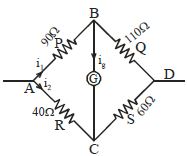
- 4In a Wheatstone bridge, $P = 90\,\Omega $, $Q = 110\,\Omega $ , $R = 40\,\Omega $ and $S = 60\,\Omega $ and a cell of $4\,V\,emf$. Then the potential difference between the diagonal along which a galvanometer is connected is ............. $V$View Solution
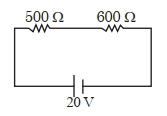
- 5Two resistors are connected in series across a battery as shown in figure. If a voltmeter of resistance $2000 \,\Omega$ is used to measure the potential difference across $500 \,\Omega$ resister, the reading of the voltmeter will be ............... $V$View Solution
- 6A storage battery is connected to a charger for charging with a voltage of $12.5\,\,Volts$. The internal resistance of the storage battery is $1\,\,\Omega$ . When the charging current is $0.5\,\,A$, the emf of the storage battery is: ............... $volts$View Solution
- 7A battery of internal resistance one ohm and $emf$ $3\,volt$ sends a current through $1\,metre$ of uniform wire of resistance $5\,\Omega $. The pole of the cell of $emf$ $1.4\,volt$ are connected to two points on the wire so that no current passes through this cell. Then, the potential gradient of the wire isView Solution
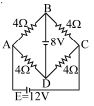
- 8The given figure shows $a$ network of resistances and $a$ battery. Choose the correct statement $(s)$.View Solution
- 9If $n, e, \tau$ and $m$ are representing electron density, charge, relaxation time and mass of an electron respectively, then the resistance of a wire of length / and cross-sectional area $A$ is given byView Solution
- 10In a meter bridge the point $D$ is neutral point as shown in the figure.View Solution