Electric charges of $+10\,\mu\, C, +5\,\mu\, C, -3\,\mu\, C$ and $+8\,\mu\, C$ are placed at the corners of a square of side$\sqrt 2\,m$ . The potential at the centre of the square is
Medium
Download our app for free and get started
$\mathrm{V}_{\mathrm{net}}=\mathrm{V}_{1}+\mathrm{V}_{2}+\mathrm{V}_{3}+\mathrm{V}_{4}$
$=\frac{9 \times 10^{9}}{1}[+10+5-3+8] \times 10^{-6} \quad\left[\because \mathrm{r}=\frac{\mathrm{a} \sqrt{2}}{2}=1\right]$
$\mathrm{V}_{\mathrm{net}}=180 \times 10^{3}=1.8 \times 10^{5} \mathrm{\,V}$

Download our appand get started for free
Experience the future of education. Simply download our apps or reach out to us for more information. Let's shape the future of learning together!No signup needed.*
Similar Questions
- 1The electric potential at the surface of an atomic nucleus $(Z = 50)$ of radius $9.0×{10^{ - 13}}\, cm$ isView Solution
- 2A capacitor of capacitance $C_1 = 1\ \mu F$ can with stand maximum voltage $V_1= 6\ kV$ (kilo-volt) and another capacitor of capacitance $ C_2 = 3\ \mu F$ can withstand maximum voltage $V_2 = 4\ kV$. When the two capacitors are connected in series, the combined system can withstand a maximum voltage of......$kV$View Solution
- 3The plates of parallel plate capacitor are charged upto $100\;V$. A $2\,mm$ thick plate is inserted between the plates. Then to maintain the same potential difference, the distance between the plates is increased by $1.6\;mm$. The dielectric constant of the plate isView Solution
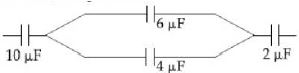
- 4In the figure shown below, the charge on the left plate of the $10\, \mu F$ capacitor is $-30\,\mu C.$ The charge on the right place of the $6\,\mu F$ capacitor is.....$\mu C$View Solution
- 5View SolutionA long, hollow conducting cylinder is kept coaxially inside another long, hollow conducting cylinder of larger radius. Both the cylinders are initially electrically neutral.
- 6A parallel plate capacitor has plates with area $A$ and separation $d$ . A battery charges the plates to a potential difference $V_0$ . The battery is then disconnected and a dielectric slab of thickness $d$ is introduced. The ratio of energy stored in the capacitor before and after the slab is introduced, isView Solution
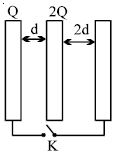
- 7Three large plates are arranged as shown. How much charge will flow through the key $k $ if it is closed?View Solution
- 8Two charged particles of masses $m$ and $2m$ have charges $+2q$ and $+q$ respectively. They are kept in uniform electric field and allowed to move for some time. The ratio of their kinetic energies will beView Solution
- 9Charge $Q$ is given a displacement $\vec r = a\hat i + b\hat j$ in an electric field $\vec E = E_1\hat i + E_2\hat j$ . The work done isView Solution
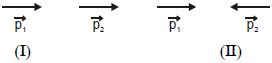
- 10View SolutionFor shown situation of two dipoles the nature of forces between them are