MCQ
Electric conduction in a semiconductor takes place due to:
  • A
    Electrons only.
  • B
    Holes only.
  • Both electrons and holes.
  • D
    Neither electrons nor holes.

Answer

Correct option: C.
Both electrons and holes.
A hole is created in a semiconductor when a valence electron moves to the conduction band. When potential difference is applied across the semiconductor, the electron drifts opposite to the electric field applied, while the hole moves along the electric field. Therefore, electric conduction takes place in a semiconductor because of both electrons and holes.

Need a full question paper?

Generate a complete, print-ready paper with questions like this in minutes — across 16+ boards, with answer keys.
Start Generating Free

Similar questions

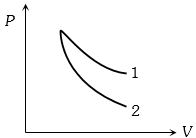
$P-V$ plots for two gases during adiabatic process are shown in the figure. Plots $1$ and $2$ should correspond respectively to
The excess pressure inside a soap bubble is twice the excess pressure inside a second soap bubble. The volume of the first bubble is n times the volume of the second where n is:
The respective speeds of five molecules are $2, 1.5, 1.6, 1.6$ and $1.2 \,km/sec.$ The most probable speed in $km/sec$ will be
A tuning fork of frequency 512Hz is vibrated with a sonometer wire and 6 beats per second are heard. The beat frequency reduces if the tension in the string is slightly increased. The original frequency of vibration of the string is:
A tennis ball dropped from a height of $2 \,m$ rebounds only $1.5 \,m$ after hitting the ground. What fraction of its energy is lost in the impact
All the graphs below are intended to represent the same motion. One of them does it incorrectly. Pick it up.
Two discs of same mass and same thickness have densities as $17 \,g / cm ^3$ and $51 \,g / cm ^3$. The ratio of their moment of inertia about their central axes is .........
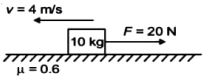
A block of mass $10 kg$ is moving on a rough surface as shown in figure. The frictional force acting on block is ...... $N$
There is rod of length $l$. The velocities of its two ends are $v_1$ and $v_2$ in opposite directions normal to the rod. The distance of the instantaneous axis of rotation from $v_1$ is:
Two particles $A$ and $B$ initially at rest move towards each other under a mutual force of attraction. The speed of centre of mass at the instant when the speed of $A$ is $v$ and the speed of $B$ is $2v$ is: