MCQ
The excess pressure inside a soap bubble is twice the excess pressure inside a second soap bubble. The volume of the first bubble is n times the volume of the second where n is:
  • A
    4
  • B
    2
  • C
    1
  • 0.125.

Answer

Correct option: D.
0.125.
Let the excess pressure inside the second bubble be P.
$\therefore$ Excess pressure inside the first bubble = 2P
Let the radius of the second bubble be R.
Let the radius of the first bubble be x.
Excess pressure inside the 2nd soap bubble:
$\text{P}=\frac{4\text{s}}{\text{R}}\ \cdots(1)$
Excess pressure inside the 1 st soap bubble:
$2\text{P}=\frac{4\text{s}}{\text{x}}$
From (1), we get:
$2\Big(\frac{2\text{S}}{\text{R}}\Big)=\frac{\text{4S}}{\text{x}}$
$\Rightarrow\text{x}=\frac{\text{R}}{2}$
Volume of the fust bubble $=\frac{4}{3}\pi\text{x}^3$
Volume of the second bubble $=\frac{4}{3}\pi\text{x}^3$
$\Rightarrow\frac{4}{3}\pi\text{x}^3=\text{n}\frac{4}{3}\pi\text{R}^3$
$\Rightarrow\text {x}^3=\text{n}\text{R}^3$
$\Rightarrow\Big(\frac{\text{R}}{2}\Big)^3=\text{n}\text{R}^3$
$\Rightarrow\text{n}=\frac{1}{8}=0.125$

Need a full question paper?

Generate a complete, print-ready paper with questions like this in minutes — across 16+ boards, with answer keys.
Start Generating Free

Similar questions

Escape velocity on earth is $11.2\, km/s$. What would be the escape velocity on a planet whose mass is $1000$ times and radius is $10$ times that of earth ......... $km/sec$​
The instantaneous angular position of a point on a rotating wheel is given by the equation $\theta $$(t)=2t^3-6t^2 $ The torque on the wheel becomes zero at $t=$ ...... $\sec$
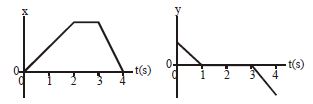
During which time interval is the particle described by these position graphs at rest?
A square wire frame of size L is dipped in a liquid. On taking out, a membrane is formed. If the surface tension of liquid is T, force acting on the frame will be
A $10 g$ bullet moving at $200 \,m / s$ stops after penetrating $5 \,cm$ of wooden plank. The average force exerted on the bullet will be .......... $N$
A circular disc of mass $10 \;kg$ is suspended by a wire attached to its centre. The wire is twisted by rotating the disc and released. The period of torsional oscillations is found to be $1.5 \;s$. The radius of the disc is $15\; cm .$ Determine the torsional spring constant of the wire in $N\;m\;rad^{-1}$. (Torsional spring constant $\alpha$ is defined by the relation $J=-\alpha \theta,$ where $J$ is the restoring couple and $\theta$ the angle of twist).
The following observations were taken for determining surface tension $T$ of water by capillary method:

diameter of capillary, $D= 1.25 \times 10^{-2}\; m$

rise of water, $h=1.45 \times 10^{-2}\; m $ 

Using $g= 9.80 \;m/s^2$ and the simplified relation $T = \frac{{rhg}}{2}\times 10^3 N/m$ , the possible error in surface tension is ........... $\%$

The ratio of the accelerations for a solid sphere (mass $m$ and radius $R$) rolling down an incline of angle $\theta$ without slipping and slipping down the incline without rolling is
The strain energy stored in a body of volume $V$ due to shear strain $\phi$ is (shear modulus is $\eta$ )
A block of mass m is placed on a smooth wedge of inclination 0. The whole system is accelerated horizontally so that the block does not slip on the wedge. The force exerted by the wedge on the block has a magnitude: