MCQ
Electric field at a point varies as ${r^o}$ for
  • A
    An electric dipole
  • B
    A point charge
  • A plane infinite sheet of charge
  • D
    A line charge of infinite length

Answer

Correct option: C.
A plane infinite sheet of charge
c
(c) $E = \sigma / (2\varepsilon _0)$

Need a full question paper?

Generate a complete, print-ready paper with questions like this in minutes — across 16+ boards, with answer keys.
Start Generating Free

Similar questions

Two capillary tubes of radii $0.2\, cm$ and $0.4\, cm$ are dipped in the same liquid. The ratio of heights through which liquid will rise in the tubes is
When the distance between the charged particles is halved, the force between them becomes
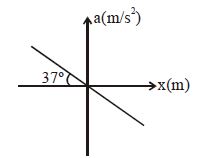
The acceleration displacement graph of a particle executing $SHM$  is shown in figure. The time period of simple harmonic motion is
A charged particle (charge $q$) is moving in a circle of radius $R$ with uniform speed $v.$ The associated magnetic moment $\mu $ is given by
The energy gap of silicon is $1.14 \ eV$. The maximum wavelength at which silicon will begin absorbing energy is.....$Å$
The foundations of dimensional analysis were laid down by
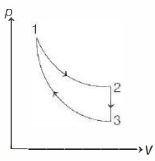
The three processes in a thermodynamic cycle shown in the figure are : Process $1 \rightarrow 2$ is isothermal; Process $2 \rightarrow 3$ is isochoric (volume remains constant); Process $3 \rightarrow 1$ is adiabatic. The total work done by the ideal gas in this cycle is $10 \,J$. The internal energy decreases by $20 \,J$ in the isochoric process. The work done by the gas in the adiabatic process is $-20 \,J$. The heat added to the system in the isothermal process is .............. $J$
At absolute zero, $Si$ acts as
The amplification factor of a triode is $50$. If the grid potential is decreased by $0.20\, V$ what increase in plate potential will keep the plate current unchanged......$V$
A particle is executing $S.H.M.$ with total mechanical energy $90 \,J$ and amplitude $6 \,cm$. If its energy is somehow decreased to $40 \,J$ then its amplitude will become ........ $cm$