MCQ
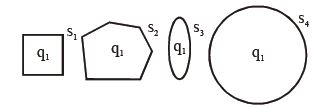
Electric flux through surface $s_1$
  • A
     is minimum
  • B
    is maximum
  • C
    equal to $s_2$ but less than $s_4$
  • equal for all surfaces

Answer

Correct option: D.
equal for all surfaces
d
Flux do not depend upon shape
 

Need a full question paper?

Generate a complete, print-ready paper with questions like this in minutes — across 16+ boards, with answer keys.
Start Generating Free

Similar questions

A particle $(A)$ moves due north at $3\,km / h$ another particle $(B)$ due west at $4\,km / h$. The relative velocity of $A$ with respect to $B$ is $\left(\tan 37^{\circ}=3 / 4\right)$
A potentiometer circuit is set up as shown. The potential gradient, across the potentiometer wire, is $k$ $volt/cm$ and the ammeter, present in the circuit, reads $1.0\,\, A$ when two way key is switched off. The balance points, when the key between the terminals $(i)$  $1$ and $2$  $(ii)$ $1$ and $3,$ is plugged in, are found to be at lengths $l_1$ and $l_2$ respectively. The magnitudes, of the resistors $R$ and $X,$ in $ohms$, are then, equal, respectively, to 
Least doped region in a transistor
An alternating $emf$ $E =440 \sin 100 \pi t$ is applited to a circuit containing an inductance of $\frac{\sqrt{2}}{\pi} H$. If an a.c. ammeter is connected in the circuit, its reading will be $.......A$
Which two of the given transverse waves will give stationary waves when get superimposed

${z_1} = a\cos (kx - \omega \,t)$.....$(A)$

${z_2} = a\cos (kx + \omega \,t)$.....$(B)$

${z_3} = a\cos (ky - \omega \,t)$..... $(C)$
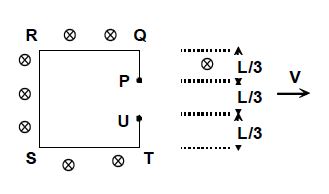
A wire frame $PQRSTU$ is moving horizontally with velocity $v$ in a uniform magnetic field $B$ acting perpendicular to its plane as shown in the figure. Choose the $INCORRECT$ statement
A vertical bar magnet is dropped from position on the axis ofafixed metallic coil as shown in fig $- I$. In fig $- II$ the magnet is fixed and horizontal coil is dropped. The acceleration of the magnet and coil are $a_1$ and $a_2$ respectively then
The depletion layer in the $ P-N$  junction region is caused by
When a potential difference $V$ is applied across a wire of resistance $R$, it dissipates energy at a rate $W$. If the wire is cut into two halves and these halves are connected mutually parallel across the same supply, the same supply, the energy dissipation rate will become:
The magnetic field at the centre due to motion electron in first Bohr orbit is $'B'$ . The magnetic field due to motion of electron in second Bohr orbit at the centre will be