MCQ
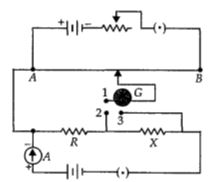
A potentiometer circuit is set up as shown. The potential gradient, across the potentiometer wire, is $k$ $volt/cm$ and the ammeter, present in the circuit, reads $1.0\,\, A$ when two way key is switched off. The balance points, when the key between the terminals $(i)$  $1$ and $2$  $(ii)$ $1$ and $3,$ is plugged in, are found to be at lengths $l_1$ and $l_2$ respectively. The magnitudes, of the resistors $R$ and $X,$ in $ohms$, are then, equal, respectively, to 
  • A
    $k(l_2 -l_1)\,Ω , kl_2\,Ω$
  • $kl_1 \,Ω , k(l_2 - l_1)\,Ω$
  • C
    $\;{\rm{k}}\left( {l_2 - l_1} \right)\,\Omega {\rm{\;}},{\rm{\;\;k}}l_1{\rm{\;}}\,\Omega {\rm{\;\;\;\;\;\;\;\;\;\;\;\;\;\;\;\;\;}}$
  • D
    $kl_1 \,Ω , kl_2\, Ω$

Answer

Correct option: B.
$kl_1 \,Ω , k(l_2 - l_1)\,Ω$
b
When the two way key is switched off, then The current flowing in the resistors $R$ and $X$ is

$I=1\, \mathrm{A}$        .......$(i)$

When the key between the terminals $1$ and $2$ is plugged in, then

Potential difference across $R=I R=k l_{1}$       ......$(ii)$

where $k$ is the potential gradient across the potentiometer wire

When the key between the terminals $1$ and $3$ is plugged in, then

Potential difference across $(R+X)=I(R+X)=k l_{2}$      ....$(iii)$

From equation $(ii),$ we get

$R=\frac{k l_{1}}{I}=\frac{k l_{1}}{1}=k l_{1} \Omega$      .......$(iv)$

From equation $(iii),$ we get

$R + X = \frac{{k{l_2}}}{I} = \frac{{k{l_2}}}{1} = k{l_2}\,\Omega \quad {\rm{ (Using }}({\rm{i}}))$

$X = k{l_2} - R$

$ = k{l_2} - k{l_1}{\rm{ }}\,\,\,\,\,\,\,\,\,\,\,{\rm{(Using}}\left( {iv} \right){\rm{)}}$

$=k\left(l_{2}-l_{1}\right) \,\Omega$

Need a full question paper?

Generate a complete, print-ready paper with questions like this in minutes — across 16+ boards, with answer keys.

Start Generating Free

Similar questions

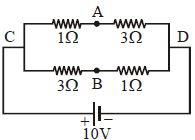
A battery of $emf$ $10\,V$ is connected to resistances as shown in the figure. The potential difference between $A$ and $B,\,\,(V_A -V_B)$ is ................ $V$
A vehicle of mass $200\,kg$ is moving along a levelled curved road of radius $70\,m$ with angular velocity of $0.2\,rad / s$. The centripetal force acting on the vehicle is $.........\,N$
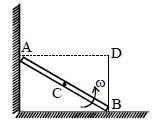
$A$ thin rod $AB$ is sliding between two fixed right angled surfaces. At some instant its angular velocity is $ \omega $. If $I_x$ represent moment of inertia of the rod about an axis perpendicular to the plane and passing through the point $X$ ($A, B, C$ or $D$), the kinetic energy of the rod is
Identify the gate and match $A, B, Y$ in bracket to check
A wooden cube first floats inside water when a $200\,g$ mass is placed on it. When the mass is removed the cube is $2\,cm$ above water level. The side of cube is ........ $cm$
The $x$ - $t$ equation is given as $x=2 t+1$ The corresponding $v-t$ graph is
The wavelength of maximum energy, released during an atomic explosion, was $2.93 × 10$$^{-{10}}$ m. Given that the Wien's constant is $2.93 × 10$$^{-{3}}$ m K, the maximum temperature attained must be of the order of
A hollow metal sphere of radius $R$ is uniformly charged. The electric field due to the sphere at a distance r from the centre
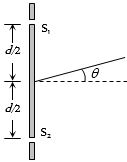
In an interference arrangement similar to Young's double slit experiment, the slits $S_1$ and $S_2$ are illuminated with coherent microwave sources each of frequency $10^6 Hz$. The sources are synchronized to have zero phase difference. The slits are separated by distance $d = 150\, m$. The intensity I$(\theta )$is measured as a function of $\theta$, where $\theta$ is defined as shown. If $I_0$ is maximum intensity, then $I(\theta )$ for $0 \le \theta \le {90^o}$is given by
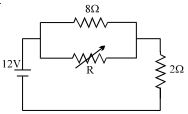
The value of the resistance $R$ in figure is adjusted such that power dissipated in the $2\,\Omega$ resistor is maximum. Under this condition