MCQ
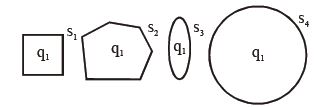
Electric flux through surface $s_1$
  • A
     is minimum
  • B
    is maximum
  • C
    equal to $s_2$ but less than $s_4$
  • equal for all surfaces

Answer

Correct option: D.
equal for all surfaces
d
Flux do not depend upon shape
 

Need a full question paper?

Generate a complete, print-ready paper with questions like this in minutes — across 16+ boards, with answer keys.

Start Generating Free

Similar questions

A flywheel rotates with a uniform angular acceleration. Its angular velocity increases from $20\pi \, rad/s$ to $40\pi \,rad/s\,m\,10\,sec$ . How many rotations did it made in this period
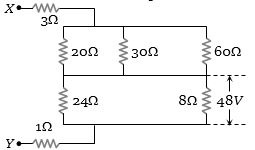
The potential difference across $8\, ohm$ resistance is $48\, volt$ as shown in the figure. The value of potential difference across $X$ and $Y$ points will be ............. $volt$
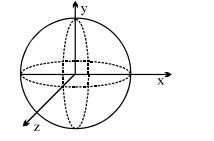
Three rings, each having equal radius $R,$ are placed mutually perpendicular to each other and each having its centre at the origin of co-ordinate system. If current $I$ is flowing thriugh each ring then the magnitude of the magnetic field at the common centre is
Two parallel wires in free space are $10\, cm$ apart and each carries a current of $10\, A$ in the same direction. The force one wire exerts on the other per metre of length is
In a closed end pipe of length $105 \,\,cm,$ standing waves are set up corresponding to the third overtone. What distance from the closed end, amongst the following, is a pressure Node ..... $cm$ ?
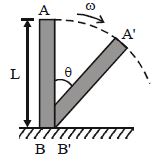
A uniform rod of length $L$ is free to rotate in a vertical plane about a fixed horizontal axis through $B$. The rod begins rotating from rest from its unstable equilibrium position. When it has turned through an angle $\theta $ its angular velocity $\omega $ is given as
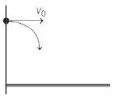
Two balls of mass $M$ and $2 \,M$ are thrown horizontally with the same initial velocity $v_{0}$ from top of a tall tower and experience a drag force of $-k v(k > 0)$, where $v$ is the instantaneous velocity. then,
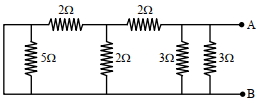
The equivalent resistance of the given circuit between the terminals ${A}$ and ${B}$ is  $....\Omega$
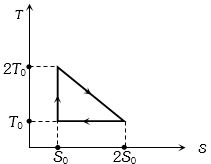
The temperature-entropy diagram of a reversible engine cycle is given in the figure. Its efficiency is
A particle moving in a straight line covers half the distance with speed $6 \mathrm{~m} / \mathrm{s}$. The other half is covered in two equal time intervals with speeds 9 $\mathrm{m} / \mathrm{s}$ and $15 \mathrm{~m} / \mathrm{s}$ respectively. The average speed of the particle during the motion is :