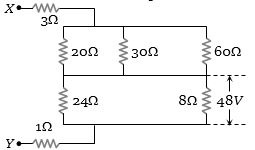
The potential difference across $8\, ohm$ resistance is $48\, volt$ as shown in the figure. The value of potential difference across $X$ and $Y$ points will be ............. $volt$
Diffcult
Download our app for free and get started
(a) The given circuit can be redrawn as follows
Resistance between $A$ and $B$ $ = \frac{{24 \times 8}}{{32}} = 6\,\Omega $
Current between $A$ and $B$ = Current between $X$ and $Y$ $ = i = \frac{{48}}{6} = 8\,A$
Resistance between $X$ and $Y$ $ = (3 + 10 + 6 + 1) = 20\,\Omega $
$==>$ Potential difference between $X$ and $Y$ = $8 × 20 = 160 \,V$
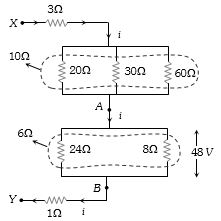
Resistance between $A$ and $B$ $ = \frac{{24 \times 8}}{{32}} = 6\,\Omega $
Current between $A$ and $B$ = Current between $X$ and $Y$ $ = i = \frac{{48}}{6} = 8\,A$
Resistance between $X$ and $Y$ $ = (3 + 10 + 6 + 1) = 20\,\Omega $
$==>$ Potential difference between $X$ and $Y$ = $8 × 20 = 160 \,V$

Download our appand get started for free
Experience the future of education. Simply download our apps or reach out to us for more information. Let's shape the future of learning together!No signup needed.*
Similar Questions
- 1In the given circuit diagram, find the current passing through wire $CD$ (in ampere)View Solution
- 2Two wires have resistance of $2$ $\Omega$ and $4$ $\Omega$ connected to same voltage, ratio of heat dissipated at resistance isView Solution
- 3The resistance of a wire is $R$. If the length of the wire is doubled by stretching, then the new resistance will beView Solution
- 4Two resistors of resistance $R_1$ and $R_2$ having $R_1 > R_2$ are connected in parallel. For equivalent resistance $R$, the correct statements isView Solution
- 5In an electrical cable there is a single wire of radius $9\, mm$ of copper. Its resistance is $5\,\Omega $. The cable is replaced by $6$ different insulated copper wires, the radius of each wire is $3\,mm$. Now the total resistance of the cable will be ............... $\Omega$View Solution
- 6A current $I$ is passing through a wire having two sections $P$ and $Q$ of uniform diameters $d$ and $d/2$ respectively. If the mean drift velocity of electrons in sections $P$ and $Q$ is denoted by $v_P$ and $v_Q$ respectively, thenView Solution
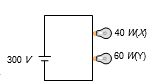
- 7Two bulbs $X$ and $Y$ having same voltage rating and of power $40\, watt$ and $60\, watt$ respectively are connected in series across a potential difference of $300\, volt$, thenView Solution
- 8View SolutionGiven three equal resistors, how many different combination of all the three resistors can be made
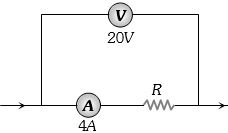
- 9In the diagram shown, the reading of voltmeter is $20\, V$ and that of ammeter is $4\, A$. The value of $R$ should be (Consider given ammeter and voltmeter are not ideal)View Solution
- 10The circuit shown here is used to compare the emf of two cells $E_1$ and $E_2 (E_1 > E_2)$. The null point is at $C$ when the galvanometer is connected to $E_1$. When the galvanometer is connected to $E_2$, the null point will beView Solution