Question
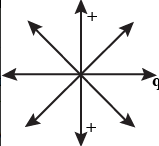
Electric lines of force about a positive point charge are:

Answer

  1. Radially outwards.
Explanation:
Electric lines of force about a positive point charge are always radially outwards.

Need a full question paper?

Generate a complete, print-ready paper with questions like this in minutes — across 16+ boards, with answer keys.
Start Generating Free

Similar questions

The ratio of the refractive index of red light to blue light in air is(a) Less than unity(b) Equal to unity(c) Greater than unity(d) Less as well as greater than unity depending upon the experimental arrangement


The two waves represented by $y_1=a \sin (\omega t)$ and $\mathrm{y}_2=\mathrm{b} \cos (\omega \mathrm{t})$ have a phase difference of
The half life of $131_I$ is $8$ days. Given a sample of $131_I$ at time $t = 0,$ we can assert that
A medium is said to be dispersive, if(a) Light of different wavelengths propagate at different speeds(b) Light of different wavelengths propagate at same speed but has different frequencies(c) Light is gradually bent rather than sharply refracted at an interface between the medium and air(d) Light is never totally internally reflected


If a body is charged by rubbing it, its weight
  1. Remains precisely constant.
  2. Increases slightly.
  3. Decreases slightly.
  4. May increase slightly or may decrease slightly.
A proton and an electron are placed in a uniform electric field.
Assertion  :   Light is produced in gases in the process of electric discharge through them at high pressure.
Reason     :  At high pressure electrons of gaseous atoms collide and reach and excited state.(a) If both assertion and reason are true and the reason is the correct explanation of the assertion.(b) If both assertion and reason are true but reason is not the correct explanation of the assertion.(c) If assertion is true but reason is false.(d) If the assertion and reason both are false.


The charge on proton is:
Atomic number of a nucleus is Z and atomic mass is M. The number of neutron is(a) M - Z(b) M(c) Z  (d) M + Z
       
The period of oscillations of a magnet is 2 sec. When it is remagnetised so that the pole strength is 4 times its period will be(a) 4 sec               (b) 2 sec(c) 1 sec  (d) 1/2 sec