Question
Electrical work done in unit time is equal to electrical potential multiplied by total charge passed. ln order to obtain maximum work from a cell, the charge has to be passed reversibly. The reversible work done by a cell is equal to decrease in its Gibb's energy. Hence, Gibb's energy of reaction is given by
$\Delta\text{G}=\text{nFE}_\text{cell}$
Hence, Eis the emfof the cell and nFis the amount of energy.
In these questions (Q. No. i-Iv), a statement of assertion followed by a statement ofreason is given. Choose the correct answer out of the following choices.
  1. Assertion and reason both are correct statements and reason is correct explanation for assertion.
  2. Assertion and reason both are correct statements but reason is not correct explanation for assertion.
  3. Assertion is correct statement but reason is wrong statement.
  4. Assertion is wrong statement but reason is correct statement.
  1. Assertion: $\Delta\text{G}^\circ=-\text{nFE}^\circ$
Reason: E should be positive for a spontaneous reaction.
  1. Assertion: An electrochemical cell can be set up only if the red ox reaction is spontaneous.
Reason: A reaction is spontaneous if free energy change is negative.
  1. Assertion: For an electrochemical cell, $\Delta\text{G}<0$ and $\text{E}_\text{cell}>0.$
Reason: The given cell is non-spontaneous.
  1. Assertion: Current stops flowing when $E_{cell} = 0.$
Reason: Equilibrium of the cell reaction is attained.
  1. Assertion: $E_{cell}$ should have a positive value for the cell to function.
Reason: $E_{cell} = E_{cathode} - E_{anode}$

Answer

  1. (b) Assertion and reason both are correct statements but reason is not correct explanation for assertion.
  1. (b) Assertion and reason both are correct statements but reason is not correct explanation for assertion.
Explanation:

If redox reaction is spontaneous, $\Delta\text{G}$ is -ve and hence, $E^\circ$ is positive.

$-\Delta\text{G}^\circ=\text{nFE}^\circ\text{cell}$
  1. (c) Assertion is correct statement but reason is wrong statement.
Explanation:

$\Delta\text{G}<0$ and $\text{E}_\text{cell}>0$ ; spontaneous.
  1. (a) Assertion and reason both are correct statements and reason is correct explanation for assertion.
  1. (b) Assertion and reason both are correct statements but reason is not correct explanation for assertion.

Need a full question paper?

Generate a complete, print-ready paper with questions like this in minutes — across 16+ boards, with answer keys.

Start Generating Free

Similar questions

In these questions, a statement of assertion followed by a statement of reason is given. Choose the correct answer out of the following choices.
Assertion: The molecules on the surface have lesser energy than the molecules inside.
Reason: During adsorption, the surface of solid is in a state of strain.
Read the passage given below and answer the following questions:
The transition elements have incompletely filled d-subshells in their ground state or in any of their oxidation states. The transition elements occupy position in betweens- and p-blocks in groups $3-12$ of the Periodic table. Starting from fourth period, transition elements consists of four complete series : Sc to $Zn, Y$ to Cd and La, $Hf$ to $Hg$ and $Ac, Rf$ to $Cn$. In general, the electronic configuration of outer orbitals of these elements is $(n - 1)d^{1-10} n^{1-2}$. The electronic configurations of outer orbitals of $Zn, Cd, Hg$ and $Cn$ are represented by the general formula $(n - 1)d^{10}ns^2$. All the transition elements have typical metallic properties such as high tensile strength, ductility, malleability. Except mercury, which is liquid at room temperature, other transition elements have typical metallic structures. The transition metals and their compounds also exhibit catalytic property and paramagnetic behaviour. Transition metal also forms alloys. An alloy is a blend of metals prepared by mixing the components. Alloys may be homogeneous solid solutions in which the atoms of one metal are distributed randomly among the atoms of the other.
The following questions are multiple choice questions. Choose the most appropriate answer:
  1. Which of the following characteristics of transition metals is associated with higher catalytic activity?
  1. High enthalpy of atomisation.
  2. Variable oxidation states.
  3. Paramagnetic behaviour.
  4. Colour of hydrated ions.
  1. Transition elements form alloys easily because they have.
  1. Same atomic number.
  2. Same electronic configuration.
  3. Nearly same atomic size.
  4. Same oxidation states.
  1. The electronic configuration of tantalum $(Ta)$ is:
  1. $[Xe]4f^05d^16s^2$
  2. $[Xe]4f^{14}5d^26s^2$
  3. $[Xe]4f^{14}5d^36s^2$
  4. $[Xe]4f^{14}5d^46s^2$
  1. Which one of the following outer orbital configurations may exhibit the largest number of oxidation states?
  1. $3d^54s^1$
  2. $3d^54s^2$
  3. $3d^24s^2$
  4. $3d^34s^2$
  1. The correct statement(s) among the following is/ are:
  1. All d and f-block elements are metals.
  2. All d and f-block elements form coloured ions.
  3. All d and f-block elements are paramagnetic.
  1. $(I)$ only
  2. $(I)$ and $(II)$ only
  3. $(II)$ and $(III)$ only
  4. $(I), (II)$ and $(III)$
Read the passage given below and answer the following questions:
The halogen elements show great resemblances to one another in their chemical behaviour and properties of their compounds with other elements. There is, however, a progressive change in properties from F through $Cl, Br,$ and I to At. F is most reactive among the halogens and in fact, from all other elements and it has certain other properties that set it apart from the other halogens.
In these questions (Q.No. i - iv), a statement of assertion followed by a statement of reason is given. Choose the correct answer out of the following choices.
  1. Assertion and reason both are correct statements and reason is correct explanation for assertion.
  2. Assertion and reason both are correct statements but reason is not correct explanation for assertion.
  3. Assertion is correct statement but reason is wrong statement.
  4. Assertion is wrong statement but reason is correct statement.
  1. Assertion: $F_2 $ has high reactivity.
Reason: $F_2$ has low bond dissociation enthalpy.
  1. Assertion: The bond between $F - F$ is weaker than between $Cl - Cl.$
Reason: Atomic size of $F$ is smaller than that of $Cl.$
  1. Assertion: Fluoride does not show oxidation number greater than zero.
Reason: The halogens chlorine, bromine and iodine can show positive oxidation state of $+1, +3$ and $+7.$
  1. Assertion: F atom has less negative electron affinity than Cl atom.
Reason: Additional electrons are repelled more effectively by $3p-$electrons in $Cl$ than by $2p-$electrons in Fatom.
  1. Assertion: Fluorine is strongest oxidising agent in halogens.
Reason: It displaces other halogens from its aqueous solution.
In these questions, a statement of assertion followed by a statement of reason is given. Choose the correct answer out of the following choices.
Assertion: Colloidal particles show Brownian movement.
Reason: Brownian movement arises because of the impact of the molecules of the dispersion medium with the colloidal particles.
Dependence of the rate of reaction on the concentration of reactants, temperature, and other factors is the most general method for weeding out unsuitable reaction mechanisms. The term mechanism means all the individual collisional or elementary processes involving molecules $($atoms, radicals, and ions included$)$ that take place simultaneously or consecutively to produce the observed overall reaction. For example, when hydrogen gas reacts with bromine, the rate of the reaction was found to be proportional to the concentration of $H_2$ and to the square root of the concentration of $Br_2.$ Furthermore, the rate was inhibited by increasing the concentration of $HBr$ as the reaction proceeded. These observations are not consistent with a mechanism involving bimolecular collisions of a single molecule of each kind. The currently accepted mechanism is considerably more complicated, involving the dissociation of bromine molecules into atoms followed by reactions between atoms and molecules: It is clear from this example that the mechanism cannot be predicted from the overall stoichiometry. $($source: Moore, $J. W.,$ Pearson, $R. G. (1981).$ Kinetics and mechanism. John Wiley Sons.$)$
$(a).$ Predict the expression for the rate of reaction and order for the following:
$H_2 + Br_2 \rightarrow 2 HBr$
What are the units of rate constant for the above reaction?
$(b).$ How will the rate of reaction be affected if the concentration of $Br_2$ is tripled?
Read the passage given below and answer the following questions:
(A), (B) and (C) are three non-cyclic functional isomers of a carbonyl compound with molecular formula $C_4H_8O$. Isomers (A) and (C) give positive Tollen's test whereas isomer (B) does not give Tollen's test but gives positive iodoform test. Isomers (A) and (B) on reduction with $\frac{\text{Zn(Hg)}}{\text{conc.}}.$ HCl give the same product (D).
The following questions are multiple choice questions. Choose the most appropriate answer:
  1. Compound A is:
  1. $\text{CH}_3-\text{CH}-\text{CHO}\\\ \ \ \ \ \ \ \ \ \ \ \ \ |\\ \ \ \ \ \ \ \ \ \ \ \ \ \text{CH}_3$
  2. $\text{CH}_3\text{CH}_2\text{CH}_2\text{CHO}$
  3. $\ \ \ \ \ \ \ \ \ \ \ \ \text{O}\\\ \ \ \ \ \ \ \ \ \ \ \ \ ||\\\text{CH}_3-\text{C}-\text{CH}_2-\text{CH}_3$
  4. None of these.
  1. Compound (C) is:
  1. Iso-butyraldehyde
  2. Butyraldehyde
  3. Crotonaldehyde
  4. Acrolein
  1. Compound (B) can be obtained by:
  1. $\text{CH}_3-\text{C}\equiv\text{C}-\text{CH}_2-\text{CH}_3\xrightarrow[333\text{K}]{\text{dil.H}_2\text{SO}_4+\text{HgSO}_4}$
  2. $(\text{CH}_3\text{CH}_2\text{COO})_2\text{Ca}\xrightarrow{\text{Dry distill}}$
  3. $\text{CH}_3-\text{C}\equiv\text{C}-\text{CH}_3\xrightarrow[\frac{\text{H}_2\text{O}_2}{\text{NaOH}}]{\frac{\text{B}_2\text{H}_6}{\text{THF}}}$
  4. $\text{CH}_3-\text{CH}=\text{CH}-\text{CH}_3\xrightarrow[\frac{\text{ZN}}{\text{H}_2\text{O}}]{\text{O}_3}$
  1. Out of (A), (B) and ( C) isomers, which one is least reactive towards addition of HCN?
  1. A
  2. B
  3. C
  4. All are equally reactive.
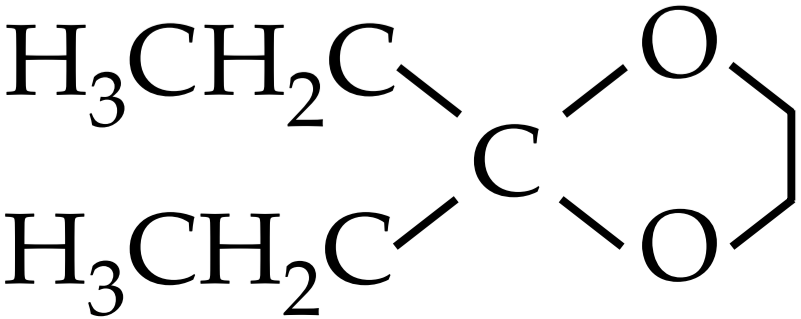
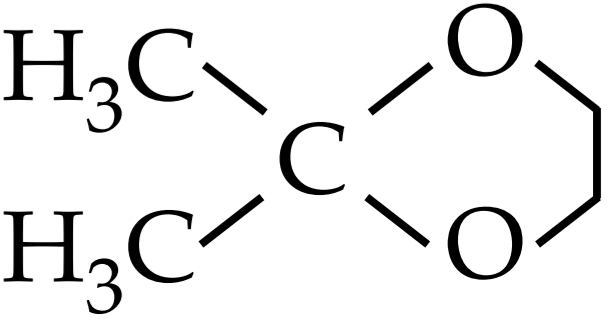
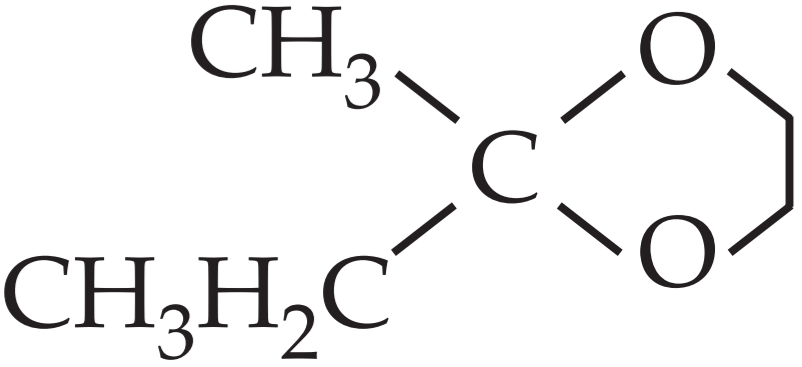
  1. What will be the product when (B) reacts with ethylene glycol in presence of HCl gas?
  1.  
  1.  
  1.  
  1. None of these.
Read the passage given below and answer the following questions:
Interhalogen compounds are formed when halogen group elements react with each other. These are the compounds which consist of two or more different elements of group$-17$. A halogen with large size and low electronegativity reacts with an element of group$-17$ with small size and high electronegativity. As the ratio of radius of larger and smaller halogen increases, the number of atoms in a molecule also increases.
The following questions are multiple choice questions. Choose the most appropriate answer:
  1. The stability of interhalogen compounds follows the order.
  1. $IF_3 > BrF_3 > CIF_3$
  2. $CIF_3 > BrF_3 > IF_3$
  3. $BrF_3 > IF_3 > CIF_3$
  4. $CIF_3 > IF_3 > BrF_3$
  1. Identify the correct match from the following.
  1. $[ICI_2]^- - $ bent.
  2. $IF_7 $- pentagonal bipyramidal.
  3. $CIF_3 $- trigonal planar.
  4. $[BrF_4]^-$ - square pyramidal.
  1. In $XA_5$, the central atom has $($both $X$ and $A$ are halogens$).$
  1. $5$ bond pairs and no lone pairs.
  2. $5$ bond pairs and one lone pair.
  3. $6$ bond pairs and no lone pairs.
  4. $4$ bond pairs and one lone pair.
  1. In the known interbalogen compounds, the maximum number of atoms are,
  1. $4$
  2. $5$
  3. $8$
  4. $7$
  1. Which of the following is not the characteristic of interhalogen compounds.
  1. They are more reactive than halogens.
  2. They are quite unstable but none of them is explosive.
  3. They are covalent in nature.
  4. They have low boiling points and are highly volatile.
All chemical reactions involve interaction of atoms and molecules. A large number of atoms/molecules are present in a few gram of any chemical compound varying with their atomic/ molecular masses. To handle such large number conveniently, the mole concept was introduced. All electrochemical cell reactions are also based on mole concept. For example, a $4.0$ molar aqueous solution of NaCl is prepared and 500mL of this solution is electrolysed. This leads to the evolution of chlorine gas at one of the electrode. The amount of products formed can be calculated by using mole concept.
The following questions are multiple choice questions. Choose the most appropriate answer:
  1. The total number of moles of chlorine gas evolved is:
  1. $0.5$
  2. $1.0$
  3. $1.5$
  4. $1.9$
  1. If cathode is a Hg electrode, then the maximum weight of amalgam formed from this solution is:
  1. $300g$
  2. $446g$
  3. $396g$
  4. $296g$
  1. The total charge (coulomb) required for complete electrolysis is:
  1. $186000$
  2. $24125$
  3. $48296$
  4. $193000$
  1. In the electrolysis, the number of moles of electrons involved are:
  1. $2$
  2. $1$
  3. $3$
  4. $4$
  1. In electrolysis of aqueous $NaCl$ solution when Pt electrode is taken, then which gas is liberated at cathode?
  1. $H_2$gas
  2. $Cl_2$gas
  3. $O_2$gas
  4. None of these.
Read the passage given below and answer the following questions:
If some solute is added to a solvent, the boiling point of solution increases. This is known as elevation in baiting point.
$\Delta\text{T}_\text{b}=\text{K}_\text{b}\text{m}$ where, $K_b =$ Molal elevation constant,
$\Delta\text{T}_\text{b}\propto\text{m}$
Hence, it is a colligative property,
Also, $\text{K}_\text{b}=\frac{\text{MRT}^2_\text{b}}{\Delta\text{Vap}\text{H}\times1000}$
where, $M =$ Molar mass of solvent,
$\Delta\text{vap}$ $H = $Enthalpy of vaporisation,
Molar mass can also be calculated using elevation in boiling point.
$\text{M}_\text{B}=\frac{\text{K}_\text{B}\times\text{W}_\text{B}\times1000}{\Delta\text{T}_\text{b}\times\text{W}_\text{A}}$
A statement of assertion followed by a statement of reason is given. Choose the correct answer out of the following choices.
  1. Assertion and reason both are correct statements and reason is correct explanation for assertion.
  2. Assertion and reason both are correct statements but reason is not correct explanation for assertion.
  3. Assertion is correct statement but reason is wrong statement.
  4. Assertion is wrong statement but reason is correct statement.
  1. Assertion: In a pressure cooker, the water is brought to boil. The cooker is then removed from the stove. Now on removing the lid of pressure cooker, the water starts boiling again.
Reason: The impurities in water bring down its boiling point.
  1. Assertion: On dissolving $3.24g$ of sulphur in $40g$ of benzene, boiling point of solution get higher than that of benzene by $0.081K$, then the formula of sulphur is $S_8. (K_b$ for benzene $= 2.53K\ kg\ mol^{-1})$
Reason: Molecular mass of sulphur comes out to be $253.$
  1. Assertion: When sugar is added to water, boiling point of water increases.
Reason: When a non-volatile solute is added to a solvent, elevation in boiling point is observed.
  1. Assertion: Cooking time in pressure cookers is reduced.
Reason: Boiling point inside the pressure cooker in raised.
  1. Assertion: Elevation in boiling point of two isotonic solutions is same.
Reason: Boiling point depends upon the concentration of the solute.
Write detailed note on: Starch