Question
Read the passage given below and answer the following questions:
The halogen elements show great resemblances to one another in their chemical behaviour and properties of their compounds with other elements. There is, however, a progressive change in properties from F through $Cl, Br,$ and I to At. F is most reactive among the halogens and in fact, from all other elements and it has certain other properties that set it apart from the other halogens.
In these questions (Q.No. i - iv), a statement of assertion followed by a statement of reason is given. Choose the correct answer out of the following choices.
  1. Assertion and reason both are correct statements and reason is correct explanation for assertion.
  2. Assertion and reason both are correct statements but reason is not correct explanation for assertion.
  3. Assertion is correct statement but reason is wrong statement.
  4. Assertion is wrong statement but reason is correct statement.
  1. Assertion: $F_2 $ has high reactivity.
Reason: $F_2$ has low bond dissociation enthalpy.
  1. Assertion: The bond between $F - F$ is weaker than between $Cl - Cl.$
Reason: Atomic size of $F$ is smaller than that of $Cl.$
  1. Assertion: Fluoride does not show oxidation number greater than zero.
Reason: The halogens chlorine, bromine and iodine can show positive oxidation state of $+1, +3$ and $+7.$
  1. Assertion: F atom has less negative electron affinity than Cl atom.
Reason: Additional electrons are repelled more effectively by $3p-$electrons in $Cl$ than by $2p-$electrons in Fatom.
  1. Assertion: Fluorine is strongest oxidising agent in halogens.
Reason: It displaces other halogens from its aqueous solution.

Answer

  1. (a) Assertion and reason both are correct statements and reason is correct explanation for assertion.
Explanation:

Fluorine is most electronegative element and has low bond dissociation enthalpy.
  1. (a) Assertion and reason both are correct statements and reason is correct explanation for assertion.
Explanation:

In $F - F$ bond, due to smaller size of fluorine, $e^- - e^-$ repulsion occur, so its bond strength is less.
  1. (b) Assertion and reason both are correct statements but reason is not correct explanation for assertion.
Explanation:

Fluorine is most electronegative element and can not exhibit any $+ve$ oxidation state. Other halogens have vacant $d-$orbitals.
  1. (c) Assertion is correct statement but reason is wrong statement.
Explanation:

Additional electrons are repelled more effectively by $2$p-electrons in F than by $3$p-electrons in Cl atom.
  1. (b) Assertion and reason both are correct statements but reason is not correct explanation for assertion.
Explanation:

The electrode potential of $F_2$ is maximum while that of $I_2$ is minimum.

Need a full question paper?

Generate a complete, print-ready paper with questions like this in minutes — across 16+ boards, with answer keys.

Start Generating Free

Similar questions

Read the passage given below and answer the following questions: An organic compound (A) having molecular formula $C_6H_6O$ gives a characteristic colour with aqueous $FeCl_3$ solution. (A) on treatment with $CO_2$ and $NaOH$ at $400K$ under pressure gives (B), which on acidification gives a compound (C). The compound (C) reacts with acetyl chloride to give (D) which is a popular pain killer. The following questions are multiple choice questions. Choose the most appropriate answer:
  1. Compound (A) is:
  1. 2-Hexanol.
  2. Dimethyl ether.
  3. Phenol.
  4. 2-Methyl pentanol.
  1. Compound (C) is:
  1. Salicylic acid.
  2. Salicyladehyde.
  3. Benzoic acid.
  4. Benzaldehyde.
  1. Number of carbon atoms in compound (D) is:
  1. 7
  2. 6
  3. 8
  4. 9
  1. The conversion of compound (A) to (C) is known as:
  1. Reimer-Tiemann reaction.
  2. Kolbe's reaction.
  3. Schimdt reaction.
  4. Swarts reaction.
  1. Compound (A) on heating with compound (C) in presence of $POCl_3$​​​​​​​ gives a compound (D) which is used:
  1. In perfumery as a ftavouring agent
  2. As an antipyretic
  3. As an analgesic
  4. As an intestinal antiseptic.
For a first order reaction, A → Products, $\text{k}=\frac{2.303}{\text{t}}\log\frac{\text{a}}{\text{a}-\text{x}},$ where a is the initial concentration of A and (a - x) is the concentration of A after time t. k is rate constant. Its value is constant at constant temperature for a reaction. The time in which half of the reactant is consumed is called half-life period. Half-life period of a first order reaction is constant. Its value is independent of initial concentration or any other external conditions.In these questions (Q. No. i-iv), a statement of assertion followed by a statement ofreason is given. Choose the correct answer out of the following choices.
  1. Assertion and reason both are correct statements and reason is correct explanation for assertion.
  2. Assertion and reason both are correct statements but reason is not correct explanation for assertion.
  3. Assertion is correct statement but reason is wrong statement.
  4. Assertion is wrong statement but reason is correct statement.
  1. Assertion: Rate of reaction doubles when concentration of reactant is doubled if it is a first order reaction.
Reason: Rate constant also doubles.
  1. Assertion: For the first order reaction, half-life period is expressed as $\text{t}_\frac{1}{2}=\frac{2.303}{\text{k}}\log2.$
Reason: The half-life time of a first order reaction is not always constant and it depends upon the initial concentration of reactants.
  1. Reason: The half-life time of a first order reaction is not always constant and it depends upon the initial concentration of reactants.
Reason: Acid only acts as a catalyst whereas alkali acts as one of the reactants.
  1. Assertion: For a first order reaction, the concentration of the reactant decreases exponentially with time.
Reason: Rate of reaction at any time depends upon the concentration of the reactant at that time.
  1. Assertion: Half-life period for a first order reaction is independent of initial concentration of the reactant.
Reason: For a first order reaction, $\text{t}_\frac{1}{2}=\frac{0.693}{\text{k}},$ where k is rate constant.
Read the passage given below and answer the following questions:
Ligands are atoms or ions which can donate electrons to the central atoms. Ligands can be monodentate, bidentate or polydentate as well. Few ligands can coordinate with the central atom through more than one site, these are called ambidentate ligands. When a di- or polydentate ligand uses its two or more donor atoms to bind a single metal ion, it is said to be a chelating ligand.
In these questions (Q. No. i-iv), a statement of assertion followed by a statement ofreason is given. Choose the correct answer out of the following choices.
  1. Assertion and reason both are correct statements and reason is correct explanation for assertion.
  2. Assertion and reason both are correct statements but reason is not correct explanation for assertion.
  3. Assertion is correct statement but reason is wrong statement.
  4. Assertion is wrong statement but reason is correct statement.
The following questions are multiple choice questions. Choose the most appropriate answer:
  1. Assertion: Glycinate ion is an example of monodentate ligand.
Reason: Glycinate contains $N$ and $O$ as donor atoms.
  1. Assertion: EDTA forms complex with divalent metals of 3d-series in the ratio of $1 : 1.$
Reason: EDTA has $4 - COOH$ groups.
  1. Assertion: Oxalate ion is a bidentate ligan.
Reason: Oxalate ion has two donor atoms.
  1. Assertion: A chelating ligand must possess two or more lone pairs at such a distance that it may form suitable strain free $5$ and $6$ membered rings with the metal ion.
Reason: $H_2N - NH_2$ is a chelating ligand.
  1. Assertion: In Zeise's salt coordination number of Pt is five.
Reason: Ethene is a monodentate ligand.
Read the passage given below and answer the following questions
Few colligative properties are:
  1. Relative lowering of vapour pressure: depends only on molar concentration of solute (mole fraction) and independent of its nature.
  2. Depression in freezing point: it is proportional to the molal concentration of solution.
  3. Elevation of boiling point: it is proportional to the molal concentration of solute.
  4. Osmotic pressure: it is proportional to the molar concentration of solute
A solution of glucose is prepared with $0.052$ g at glucose in $80.2$ g of water. $\left(\mathrm{KJ}=1.86 \mathrm{~K} \mathrm{~kg} \mathrm{~mol}^{-1}\right.$ and $\left.\mathrm{K}_{\mathrm{b}}=5.2 \mathrm{~K} \mathrm{~kg} \mathrm{~mol}^{-1}\right)$ The following questions are multiple choice questions. Choose the most appropriate answer:
  1. Molality of the given solution is.
  1. $0.0052m$
  2. $0.0036m$
  3. $0.0006m$
  4. $1.29m$
  1. Boiling point for the solution will be.
  1. $373.05K$
  2. $373.15K$
  3. $373.02K$
  4. $373.02K$
  1. The depression in freezing point of solution will be.
  1. $0.0187K$
  2. $0.035K$
  3. $0.082K$
  4. $0.067K$
  1. Mole fraction of glucose in the given solution is.
  1. $6.28 \times 10^{-5}$
  2. $6.28 \times 10^{-4}$
  3. $0.00625$
  4. $0.00028$
  1. If same amount of sucrose $(C_{12} H_{22} O_{11})$ is taken instead of glucose, then.
  1. Elevation in boiling point will be higher.
  2. Depression in freezing point will be higher.
  3. Depression in freezing point will be lower.
  4. Both $(a)$ and $(b).$
Read the passage given below and answer the following questions:
The unique behaviour of $Cu, $ having a positive $E^\circ$ accounts for its inability to liberate $H_2$ from acids. Only oxidising acids (nitric and hot concentrated sulphuric acid) react with $Cu,$ the acids being reduced. The stability of the half-filled $(d^5)$ subshell in $Mn^{2+}$ and the completely filled $(d^{10})$ configuration in $Zn^{2+}$ are related to their $\text{E}^\circ\frac{\text{M}^{3+}}{\text{M}^{2+}}$ values. The low value for Sc reflects the stability of $Sc^{3+}$ which has a noble gas configuration. The comparatively high value for Mn shows that $Mn^{2+}(d^5)$ is particularly stable, whereas a comparatively low value for Fe shows the extra stability of $Fe^{3+}(d^5)$. The comparatively low value for Vis related to the stability of $v^{2+} ($half-filled $t_{2g}$ level$)$.
The following questions are multiple choice questions. Choose the most appropriate answer:
  1. Standard reduction electrode potential of $\frac{\text{Zn}^{2+}}{\text{Zn}}$ is 0.76V. This means
  1. $ZnO$ cannot be reduced to $Zn$ by $H_2$ under standard conditions.
  2. $Zn$ cannot liberate $H_2$ with concentrated acids.
  3. $Zn$ is generally the anode in an electrochemical cell.
  4. $Zn$ is generally the cathode in an electrochemical cell.
  1. $\text{E}^\circ$ values for the couples $\frac{\text{Cr}^{3+}}{\text{Cr}^{2+}}$ and $\frac{\text{Mn}^{3+}}{\text{Mn}^{2+}}$ are $-0.41$ and $+1.51$ volts respectively. These values suggest that.
  1. $Cr^{2+}$ acts as a reducing agent whereas $Mn^{3+}$ acts as an oxidizing agent.
  2. $Cr^{2+}$ is more stable th an $Cr^{3+}$ state.
  3. $Mn^{3+}$ is more stable than $Mn^{2+}$.
  4. $Cr^{2+}$ acts as an oxidizing agent whereas $Mn^{3+}$ acts as a reducing agent..
  1. The reduction potential values of $M, N$ and $O$ are $+2.46, -1.13$ and $-3.13V$ respectively. Which of the following order is correct regarding their reducing property?
  1. $O > N > M$
  2. $O > M > N$
  3. $M > N > O$
  4. $M > O > N$
  1. Which of the following statements are true?
  1. $Mn^{2+}$ compounds are more stable than $Fe^{2+}$ towards oxidation to $+3$ state.
  2. Titanium and copper both in the first series of transition metals exhibits $+1$ oxidation state most frequently.
  3. $Cu^+$ ion is stable in aqueous solutions.
  4. The $\text{E}^\circ$ value for the $\frac{\text{Mn}^{3+}}{\text{Mn}^{2+}}$ couple is much more positive than that for $\frac{\text{Cr}^{3+}}{\text{Cr}^{2+}}$ or $\frac{\text{Fe}^{3+}}{\text{Fe}^{2+}}.$.
  1. $(II)$ and $(III)$
  2. $(I)$ and $(IV)$
  3. $(I)$ and $(III)$
  4. $(II)$ and $(IV)$
  1. The stability of $\text{Cu}^{2+}_\text{(aq)}$ rather than $\text{Cu}^{+}_\text{(aq)}$ is due to.
  1. More negative $\Delta_\text{hyd}\text{H}^\circ$ of $\text{Cu}^{2+}_\text{(aq)}.$
  2. Less negative $\Delta_\text{hyd}\text{H}^\circ$ of $\text{Cu}^{2+}_\text{(aq)}.$
  3. More positive $\Delta_\text{hyd}\text{H}^\circ$ of $\text{Cu}^{2+}_\text{(aq)}.$
  4. Less positive $\Delta_\text{hyd}\text{H}^\circ$ of $\text{Cu}^{2+}_\text{(aq)}.$
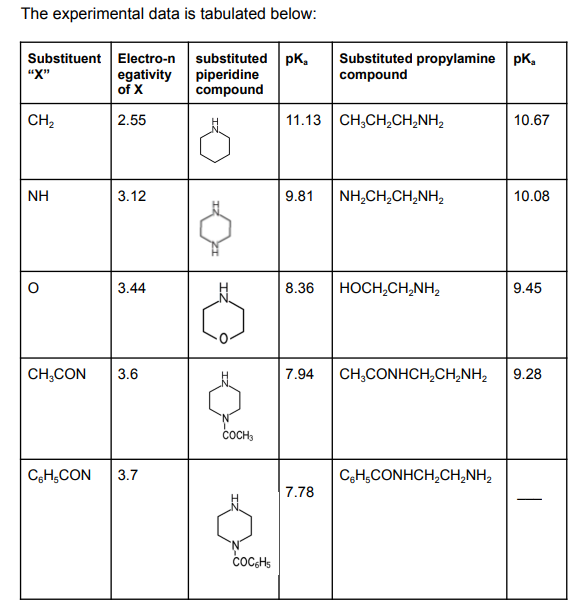
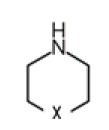
Amines are basic in nature. The $pK_b$ value is a measure of the basic strength of an amine. Lower the value of $pK_b$ more basic is the amine. The effect of substituent on the basic strength of amines in aqueous solution was determined using titrations. The substituent $"X"$ replaced $"-CH_2"$ group in piperidine $($ compound $1)$ and propylamine $CH_3CH_2CH_2NH_2, ($compound $2).$
Compound $1:$
Image
Compound $2: HXCH_2CH_2NH_2$
Image
(source: Hall Jr, $H. K. (1956).$ Field and inductive effects on the base strengths of amines. Journal of the American Chemical Society, $78(11), 2570-2572.) $
Study the above data and answer the following questions:
$a.$ Plot a graph between the electronegativity of the substituent vs $pK_b$ value of the corresponding substituted propyl amine $($ given that $pK_a + pK_b =14).$ Is there any relation between the electronegativity of the substituent and its basic strength?
$b.$ The electronegativity of the substituent $"C6H5CON\ "$ is $3.7,$ what is the expected pKa value of compound $C_6H_5CONHCH_2CH_2NH_2?$
$(i) \ 9.9 \ (ii) \ 9.5 \ (iii) \ 9.3 \ (iv) \ 9.1$
$c.$ The pKa value of the substituted piperidine formed with substituent $"X\ "$ is found to be $8.28.$ What is the expected electronegativity of $"X\ "$
$(i)\ 3.5 \ (ii)\ 3.4 \ (iii)\ 3.8\ (iv) \ 3.1$

Read the passage given below and answer the following questions:
When a solution of an et-amino acid is placed in an electric field depending on the pH of the medium, following three cases may happen.
  1. In alkaline solution, CL-amino acids exist as anion II, and there is a net migration of amino acid towards the anode.
  2. In acidic solution, a-amino acids exist as cation III, and there is a net migration of amino acid towards the cathode.
  3. If II and III are exactly balanced there is no net migration; under such conditions any one molecule exists as a positive ion and as a negative ion for exactly the same amount of time, and any small movement in the direction of one electrode is subsequently cancelled by an equal movement back toward the other electrode. The pH of the solution in which a particular amino acid does not migrate under the influence of an electric field is called the is oelectric point of that amino acid.
The following questions are multiple choice questions. Choose the most appropriate answer:
  1.  

Arrange in order of increasing acid strengths.
  1. X > Z > Y
  2. Z < X < Y
  3. X > Y > Z
  4. Z > X > Y
  1. In aqueous solutions, amino acids mostly exist as:
  1. $NH_2 - CHR - COOH$
  2. $NH_2 - CHR - COO^-$
  3. $\stackrel{+}{\hbox{ N}}\text{H}_3\text{CHRCOOH}$
  4. $\text{H}_3\stackrel{{+}}{\hbox{N}}\text{CHRCOO}^-$
  1. Amino acids are least soluble:
  1. at pH 1
  2. at pH 7
  3. At their isoelectric points.
  4. None of these.
  1. The $\text{pK}_{\text{a}_1}$ and $\text{pK}_{\text{a}_2}$ of an amino acid are 2.3 and 9.7 respectively. The is oelectric point of the amino acid is:
  1. 12.0
  2. 7.4
  3. 6.0
  4. 3.7
  1. A tripeptide (X) on partial hydrolysis gave two dipeptides Cys-Gly and Glu-Cys. Identify the tripeptide.
  1. Glu-Cys-Gly
  2. Gly-Glu-Cys
  3. Cys-Gly-Glu
  4. Cys-Glu-Gly
Read the passage given below and answer the following questions: Williamson's synthesis is used for the preparation of symmetrical as well as unsymmerical ether. It is $S_N2$ reaction mechanism. In Williamson's synthesis, $1º$ alkyl halide are used for preparation of ethers because $2º$ and $3º$ alkyl halide give alkene. Ethers are cleaved by hydrogen halides to alcohol and alkyl halide where alkyl halide is corresponding to that alkyl which has less number of carbon atom (it is because of less steric hindrance). In polar media unsymmetrical ether like tertiary butyl ethyl ether gives ethyl alcohol and tertiary butyl halide as reaction proceeds via carbocation. In these questions (Q. No. i-iv), a statement of assertion followed by a statement of reason is given. Choose the correct answer out of the following choices.
  1. Assertion and reason both are correct statements and reason is correct explanation for assertion.
  2. Assertion and reason both are correct statements but reason is not correct explanation for assertion.
  3. Assertion is correct statement but reason is wrong statement.
  4. Assertion is wrong statement but reason is correct statement.
  1. Assertion: Rate of reaction of alkyl halide in Williamson's synthesis reaction is 1ºRX > 2ºRX > 3ºRX.
Reason: It is a type of bimolecular substitution reaction $(S_N2)$.
  1. Assertion: T-Butyl methyl ether is not prepared by the reaction of t-butyl bromide with sodium methoxide.
Reason: Sodium methoxide is a weak nucleophile.
  1. Assertion: Williamson's synthesis method cannot be used for preparing diphenyl ether.
Reason: Aryl halides do not undergo nucleophilic substitution easily.
  1. Assertion: When isopropyl bromide is treated with sodium isopropoxide, di-isopropyl ether is obtained as a major product.
Reason: With secondary alkyl halides, both substitution and elimination occur.
  1. Assertion: Both symmetrical and unsymmetrical ethers can be prepared by Williamson's synthesis.
Reason: Williamson's synthesis is an example of nucleophilic substitution reaction.
Read the passage given below and answer the following questions: Amines are alkyl or aryl derivatives of ammonia formed by replacement of one or more hydrogen atoms. Alkyl derivatives are called aliphatic amines and aryl derivatives are known as aromatic amines. The presence of aromatic amines can be identified by performing dye test. Aniline is the simplest example of aromatic amine. It undergoeselectrophilic substitution reactions in which $-NH_2$ group strongly activates the aromatic ring through delocalisation of lone pair of electrons of N-atom. Aniline undergoes electrophilic substitution reactions. Ortho and para positions to the $-NH_2$ group become centres of high electrons density. Thus, $-NH_2$ group is ortho and para-directing and powerful activating group. The following questions are multiple choice questions. Choose the most appropriate answer:
  1. Cyclohexylamine and aniline can be distinguished by:
  1. Hinsberg test.
  2. carbylamine test.
  3. Lassaigne test.
  4. azo dye test.
  1. Which of the following compounds gives dye test?
  1. Aniline.
  2. Methyl amine.
  3. Diphenyl amine.
  4. Ethyl amine.
  1. Aniline when acetylated, the major product on nitration followed by alkaline hydrolysis gives:
  1. Acetanilide.
  2. o-nitroacetanitide.
  3. p-nitroaniline.
  4. m-nitroanitine.
  1. Oxidation of aniline with manganese dioxide and sulphuric acid produces:
  1. Phenylhydroxylamine.
  2. Nitrobenzene.
  3. p-benzoquinone.
  4. Phenol.
  1. Aniline when treated with cone. $HNO_3$ and $H_2S0_4$ gives:
  1. p-phenylenediamine.
  2. m-nitroaniline.
  3. p-benzoquinone.
  4. Nitrobenzene.
Read the passage given below and answer the following questions:
In hexagonal system of crystals, a frequently encountered arrangement of atoms, is described as a hexagonal prism. Here, the top and bottom of the cell are regular hexagons and three atoms are sandwiched in between them. A space-filling model of this structure, called hexagonal close packed (hep), is constituted of a sphere on a flat surface surrounded in the same plane by six identical spheres as closely as possible. Three spheres are then placed over the first layer so that they touch each other and represent the second layer. Each one of these three spheres touches three spheres of the bottom layer. Finally, the second layer is covered with a third layer that is identical to the bottom layer in relative position.
The following questions are multiple choice questions. Choose the most appropriate answer:
  1. The number of atoms in this hep unit cell is.
  1. 4
  2. 6
  3. 12
  4. 17
  1. The number of atoms in this hep unit cell is.
  1. $24\sqrt{2\pi^3}$
  2. $16\sqrt{2\text{r}^3}$
  3. $12\sqrt{2\text{r}^3}$
  4. $\frac{64}{3\sqrt{3}}\text{r}^3$
  1. The empty space in this hcp unit cell is.
  1. 74%
  2. 47.6%
  3. 32%
  4. 26%
  1. Which of the following statements is correct about hexagonal close packing?
  1. In this arrangement, third layer is identical to the first layer.
  2. The coordination number in this arrangement is 6.
  3. It is as closely packed as body centered cubic packing.
  4. It has 32% empty space.
  1. In hexagonal close packing of spheres in three-dimensions.
  1. In one unit cell there are 12 octahedral voids and all are completely inside the unit cell.
  2. In one unit cell there are six octahedral voids and all are completely inside the unit cell.
  3. In one unit cell there are six octahedral voids out of which three are completely inside the unit cell and other three are from contributions of octahedral voids which are partially inside the unit cell.
  4. In one unit cell there are 12 tetrahedral voids, all are completely inside the unit cell.