Question
Electrolysis is a redox process. Explain.

Answer

Electrolysis is a redox process. The reaction at the cathode involves reduction of cations as they gain of electrons while the reaction at anode involves oxidation of anions as they loss of electrons to become neutral.
Example: Dissociation of sodium chloride during electrolysis.
$NaCl ⇌ Na^+ + Cl^-$​​​​​​​
Cathode : $Na^+ + e^- ⟶ Na (reduction)$
$Cl^- − e^- ⟶ Cl(oxidation)$
$Cl + Cl ⟶ Cl_2​​​​​​​$​​​​​​​
Overall reaction : $2NaCl ⟶ 2Na + Cl_2​​​​​​​$

Need a full question paper?

Generate a complete, print-ready paper with questions like this in minutes — across 16+ boards, with answer keys.

Start Generating Free

Similar questions

The following questions relate to the extraction of aluminium by electrolysis :
(i) Name the other aluminium containing compound added to alumina and state its significance.
(ii) Give the equation for the reaction that takes place at the cathode.
(iii) Explain why is it necessary to renew the anode periodically.
Metallic properties of the elements change to non-metallic properties as one moves from left to right in a period of the periodic table. Explain.
Sodium hydroxide solution is added first in a small quantity, then in excess to the aqueous salt solutions of copper (II) sulphate, zinc nitrate, lead nitrate, calcium chloride and iron (III) sulphate. Copy the following table and write the colour of the precipitate in (i) to (v) and the nature of the precipitate (soluble or insoluble) in (vi) to (x)
Aqueous salt solution Colour of precipitate when NaOH is added in a small quantity Nature of precipitate (soluble or insoluble) when NaOH is added in excess
Copper (II) sulphate (i) (vi)
Zinc nitrate (ii) (vii)
Lead nitrate (iii) (viii)
Calcium chloride (iv) (ix)
Iron (III) Sulphate (v) (x)
Write the observations and balanced equations for the following reactions :
(i) Sodium hydroxide is added drop by drop, till in excess, in a solution of zinc sulphate.
(ii) Ammonium hydroxide is added first in small quantity and then in excess to a solution of copper sulphate.
(iii) Excess of ammonium hydroxide is added to a substance obtained by the action of hydrochloric acid in silver nitrate.
Solid ammonium dichromate decomposes as :
$
\left( NH _4\right)_2 Cr _2 O _7 \longrightarrow N _2+ Cr _2 O _3+4 H _2 O
$
If $63 g$ of ammonium dichromate decomposes. Calculate the volume of $N _2$ evolved at STP.
Choosing only substances from the list given in the box below, write equations for the reactions which you would use in the laboratory to obtain:
  1. Sodiumsulphate
  2. Coppersulphate
  3. Iron(II)sulphate
  4. Zinc carbonate
Dilute sulphuric acid Copper Copper carbonate
  Iron Sodium carbonate
  Sodium  
  Zinc  
Explain, why ammonia is evolved when water is added to the product formed, when magnesium is burned in air.
Write balanced equations for the preparation of the following :
(i) Ethane from sodium propionate
(ii) Ethanoic acid from ethane
(iii) Ethene from ethanol
State one relevant observation for each of the following reactions :
(i) Excess of ammonium hydroxide solution is added to lead nitrate solution.
(ii) Sodium hydroxide solution is added to ferric chloride solution at first a little and then in excess.
(iii) Ammonium hydroxide solution is added to copper (II) nitrate solution in small quantities and then in excess.

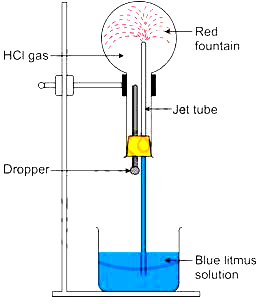
(i) Identify the gas Y.
(ii) What property of gas Y does this experiment demonstrate?
(iii) Name another gas which has the same property and can be demonstrated through this experiment.