MCQ
Electromagnetic waves are produced by:
  • A
    A static charge.
  • B
    A moving charge.
  • C
    An accelerating charge.
  • D
    Chargeless particles.

Answer

  1. An accelerating charge.

Explanation:

A static charge produces an electrostatic field. A moving charge produces a magnetic field. Electromagnetic waves are produced by an accelerating charge.

Need a full question paper?

Generate a complete, print-ready paper with questions like this in minutes — across 16+ boards, with answer keys.

Start Generating Free

Similar questions

Figure shows a horizontal solenoid connected to a battery and a switch. A copper ring is placed on a frictionless track, the axis of the ring being along the axis of the solenoid. As the switch is closed, the ring will:

Charges 4Q, q and Q and placed along x-axis at positions x = 0, x = l/2  and  x = l, respectively. Find the value of q so that force on charge Q is zero             

(a) Q

(b) Q / 2

(c) – Q / 2

(d) – Q

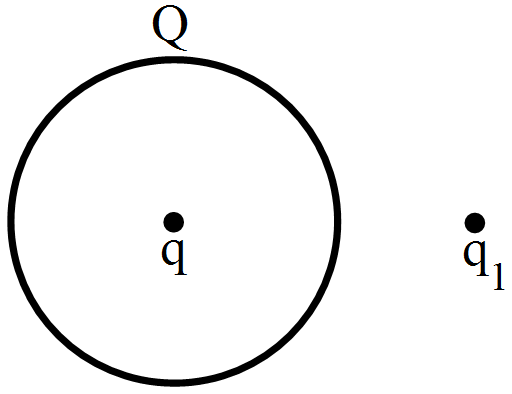
A thin, metallic spherical shell contains a charge Q on it. A point charge q is placed at the centre of the shell and another charge q1 is placed outside it as shown in figure. All the three charges are positive. The force on the charge at the centre is:

Best neutron moderator is

(a) Berillium oxide

(b) Pure water

(c) Heavy water

(d) Graphite

Monica wanted to take photographs of a monument. But since the surrounding is filled with smoke, she is not able to take good photos. Which one of the following electromagnetic waves can be used in this situation to help Monica?
The equation of a light wave is written as $\text{y}=\text{A}\ \sin(\kappa\text{x}-\omega\text{t}).$ Here, y represents:
A body moving towards a finite body at rest collides with it. It is possible that:
  1. Both the bodies come to rest.
  2. Both the bodies move after collision.
  3. The moving body comes to rest and the stationary body starts moving.
  4. The stationary body remains stationary, the moving body changes its velocity.

A parallel plate capacitor carries a charge  q. The distance between the plates is doubled by application of a force. The work done by the force is

(a) Zero  

(b)  

(c)

(d)

An ionic atom equivalent to hydrogen atom has wavelength equal to 1/4 of the wavelengths of hydrogen lines. The ion will be

(a)  

(b)  

(c)  

(d)  

Binding energy of a nucleus is of the order of.