MCQ
Electromotive force of a battery represents:
- AForce.
- BEnergy.
- CElectric potential energy per unit charge.
- DCurrent.
Explanation:
When a voltage is generated by a battery, this generated voltage has been traditionally called an electromotive force or emf. The emf represents electric potential energy per unit charge (voltage) which has been made available to free electrons by the generating mechanism and is not a force.
The term emf is useful to distinguish voltage generated by the battery from those which occur in a circuit as a result of energy dissipation( Like Voltage drop across a resistor).
Generate a complete, print-ready paper with questions like this in minutes — across 16+ boards, with answer keys.
Ge and Si diodes conduct at 0.3 V and 0.7 V respectively. In the following figure if Ge diode connection are reversed, the valve of V0 changes by
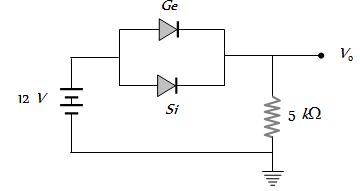
|
(a) 0.2 V |
(b) 0.4 V |
(c) 0.6 V |
(d) 0.8 V |
The grid in a triode valve is used
|
(a) To increases the thermionic emission |
|
(b) To control the plate to cathode current |
|
(c) To reduce the inter-electrode capacity |
|
(d) To keep cathode at constant potential |
Temperature above which a ferromagnetic substance becomes paramagnetic is called
| (a) Critical temperature | (b) Boyle's temperature |
| (c) Debye's temperature | (d) Curie temperature |
If m, mn and mp are the masses of  nucleus, neutron and proton respectively
|
(a) |
(b) |
|
(c) |
(d) |
A point object is placed at a distance of 30cm from a convex mirror of focal length 30cm. The image will form at:



