Question
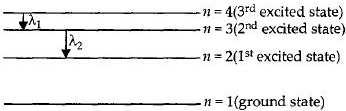
Electron in hydrogen atom first jumps from third excited state to second excited state and then from second excited to the first excited state. The ratio of the  wavelengths $\lambda_1 :\lambda_2$ emitted in the two cases is

Answer

According to Rydberg formula

$\frac{1}{\lambda}=R\left[\frac{1}{n_{f}^{2}}-\frac{1}{n_{i}^{2}}\right]$

In first case, $n_{f}=3, n_{i}=4$

$\therefore \quad \frac{1}{\lambda_{1}}=R\left[\frac{1}{3^{2}}-\frac{1}{4^{2}}\right]=R\left[\frac{1}{9}-\frac{1}{16}\right]=\frac{7}{144} R$    .... $(i)$

In second case, $n_{f}=2, n_{i}=3$

$\therefore \quad \frac{1}{\lambda_{2}}=R\left[\frac{1}{2^{2}}-\frac{1}{3^{2}}\right]=R\left[\frac{1}{4}-\frac{1}{9}\right]=\frac{5}{36} R$    .... $(ii)$

Divide $(ii)$ by $(i)$, we get

$\frac{\lambda_{1}}{\lambda_{2}}=\frac{5}{36} \times \frac{144}{7}=\frac{20}{7}$
Need a full question paper?

Generate a complete, print-ready paper with questions like this in minutes — across 16+ boards, with answer keys.

Start Generating Free

Similar questions

A person travels along a straight road for the first half time with a velocity ${v_1}$ and the next half time with a velocity ${v_2}$ . The mean velocity $V$ of the man is
A particle moves in $\mathrm{x}-\mathrm{y}$ plane under the influence of a force $\vec{F}$ such that its linear momentum is $\vec{P}(t)=\hat{i} \cos (k t)-\hat{j} \sin (k t)$. If $k$ is constant, the angle between $\overrightarrow{\mathrm{F}}$ and $\overrightarrow{\mathrm{P}}$ will be :
Reduction of aldehydes and ketones into hydrocarbons using zinc amalgam and conc. $HCl$ is called
If the amplitude ratio of two sources producing interference is $3 : 5$, the ratio of intensities at maxima and minima is
Two bodies are in equilibrium when suspended in water from the arms of a balance. The mass of one body is $36 g $ and its density is $9 g / cm^3$. If the mass of the other is $48 g$, its density in $g / cm^3$ is
The maximum current that can be measured by a galvanometer of resistance $40 \,\Omega$ is $10\, mA$. It is converted into a voltmeter that can read upto $50\, V$. The resistance to be connected in series with the galvanometer is ... (in $ohm$)
Two bodies with kinetic energies in the ratio of $4 : 1$ are moving with equal linear momentum. The ratio of their masses is
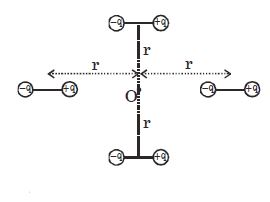
Net electric field at the given point $O$ due all the four identical short electric dipoles of dipole moment $p$ each shown in the figure is

$\left( {k = \frac{1}{{4\pi {\varepsilon _0}}}} \right)$
We are able to squeeze snow and make balls out of it because of
A particle executes simple harmonic motion along a straight line with an amplitude $A$. The potential energy is maximum when the displacement is