Electron of mass $m$ and charge $q$ is travelling with a speed along a circular path of radius $r$ at right angles to a uniform magnetic field of intensity $B$. If the speed of the electron is doubled and the magnetic field is halved the resulting path would have a radius
AIIMS 2009, Medium
Download our app for free and get started
Radius of path is given by $r=\frac{m v}{B q}$
Here, $\mathrm{m}$ and $\mathrm{q}$ remain unchanged
So, $\frac{r_{1}}{r_{2}}=\frac{v_{1}}{v_{2}} \cdot \frac{B_{2}}{B_{1}}=\frac{v}{2 v} \cdot \frac{B / 2}{B}=\frac{1}{4}$
$\Rightarrow r_{2}=4 r$

Download our appand get started for free
Experience the future of education. Simply download our apps or reach out to us for more information. Let's shape the future of learning together!No signup needed.*
Similar Questions
- 1A proton carrying $1\, Me V$ kinetic energy is moving in a circular path of radius $R$ in uniform magnetic field. What should be the energy of an $\alpha -$ particle to describe a circle of same radius in the same field ?........$MeV$View Solution
- 2The figure shows the cross section of a long cylindrical conductor through which an axial hole of radius $r$ is drilled with its centre at point $A$ . $O$ is the centre of the conductor. If an identical hole were to be drilled centred at point $B$ while maintaining the same current density the magnitude of magnetic field at $O$View Solution
- 3The resistance of a galvanometer coil is $R$. What is the shunt resistance required to convert it into an ammeter of range $4$ timesView Solution
- 4A non conducting ring (of mass $m,$ radius $r,$ having charge $Q$) is placed on a rough horizontal surface (in a region with transverse magnetic field). The field is increasing with time at the rate $R$ and coefficient of friction between the surface and the ring is $\mu .$ For ring to remain in equilibrium $\mu$ should be greater thanView Solution
- 5When a current of $5\ mA$ is passed through a galvanometer having a coil of resistance $15\ \Omega$, it shows full scale deflection. The value of the resistance to be put in series with the galvanometer to convert it into to voltmeter of range $0 - 10\ V$ isView Solution
- 6A current $I$ flows along the length of an infinitely long, straight, thin walled pipe. ThenView Solution
- 7The deflection in moving coil galvanometer falls from $25$ divisions to $5$ division when a shunt of $24\ \Omega$ is applied. The resistance of galvanometer coil will be :View Solution
- 8A voltmeter having resistance of $50 × 10^3$ $Omega$ is used to measure the voltage in a circuit. To increase the range of measurement $3$ times the additional series resistance required isView Solution
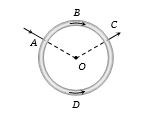
- 9A uniform wire is bent in the form of a circle of radius $R$. A current $I$ enters at $A$ and leaves at $C$ as shown in the figure :If the length $ABC$ is half of the length $ADC,$ the magnetic field at the centre $O$ will beView Solution
- 10If induction of magnetic field at a point is $B$ and energy density is $U$ then which of the following graphs is correctView Solution