The resistance of a galvanometer coil is $R$. What is the shunt resistance required to convert it into an ammeter of range $4$ times
Medium


Download our appand get started for free
Experience the future of education. Simply download our apps or reach out to us for more information. Let's shape the future of learning together!No signup needed.*
Similar Questions
- 1A steady current $i$ flows in a small square loop of wire of side $L$ in a horizontal plane. The loop is now folded about its middle such that half of it lies in a vertical plane. Let $\overrightarrow {{\mu _1}} $ and $\overrightarrow {{\mu _2}} $ respectively denote the magnetic moments due to the current loop before and after folding. ThenView Solution
- 2A galvanometer having a resistance $G$ and current $I_g$ flowing in it, produces full scale defection. If $S_1$ is the value of shunt which converts it into an ammeter of range $0-I$ and $S_2$ is the value of shunt for range $0-8I$ . Then the ratio $\frac {S_1}{S_2}$ will beView Solution
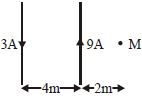
- 3Magnetic field at point $'M'$ of given current distributionView Solution
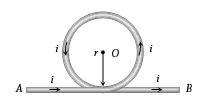
- 4A part of a long wire carrying a current $i$ is bent into a circle of radius $r$ as shown in figure. The net magnetic field at the centre $O$ of the circular loop isView Solution
- 5There are three voltmeters of the same range but of resistances $10000\,\Omega $, $8000\,\Omega $ and $4000\,\Omega $ respectively. The best voltmeter among these is the one whose resistance is ................ $\Omega $View Solution
- 6The relation between voltage sensitivity (${\sigma _V}$) and current sensitivity $({\sigma _i})$ of a moving coil galvanometer is (Resistance of Galvanometer = $G$)View Solution
- 7The magnetic moment of a current $(i)$ carrying circular coil of radius $(r)$ and number of turns $(n)$ varies asView Solution
- 8A particle having charge of $1 \,\,C$, mass $1 \,\,kg$ and speed $1 \,\,m/s$ enters a uniform magnetic field, having magnetic induction of $1$ $T,$ at an angle $\theta = 30^o$ between velocity vector and magnetic induction. The pitch of its helical path is (in meters)View Solution
- 9A rectangular loop of wire shown below is coplanar with a long wire carrying current $I$. The loop is pulled to the right a s indicated. What are the directions of the induced current in the loop and the magnetic forces on the left and the right sides of the loop?View Solution
Induced current Force on left side Force on right side $a.$ Counter clockwise To the left To the right $b.$ clockwise To the left To the right $c.$ Counter clockwise To the right To the left $d.$ clockwise To the right To the left 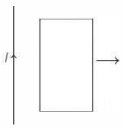
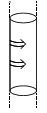
- 10A hollow cylinder having infinite length and carrying uniform current per unit length $\lambda$ along the circumference as shown. Magnetic field inside the cylinder isView Solution