MCQ
Electron volt is a unit of
  • A
    Charge
  • B
    Potential difference
  • C
    Momentum
  • Energy

Answer

Correct option: D.
Energy
d
(d) The electron volt (symbol ev; also written electronvolt) is a unit of energy equal to approximately $\left.1.602 \times 10^{-19} \text { joule (SI unit } \mathrm{J}\right)$

By definition, it is the amount of energy gained by the charge of a single electron moved across an electric potential difference of one volt.

Hence, the correct option is $d$

Need a full question paper?

Generate a complete, print-ready paper with questions like this in minutes — across 16+ boards, with answer keys.

Start Generating Free

Similar questions

If for an inclined plane coefficient of static friction is ${\mu _s} = \frac{3}{4}$, then for the inclined plane angle of repose will be ........ $^o$
An infinite number of charges each numerically equal to q and of the same sign are placed along the $x-$ axis at $x = 1,2,4,8.... \,metres$. Then the electric potential at $x = 0$ due to this set of charges is
A piece of fuse wire melts when a current of $15\, ampere$ flows through it. With this current, if it dissipates $22.5\, W$, the resistance of fuse wire will be .............. $\Omega$
Given below are two statements:

$Statement$ $I$ : If a capillary tube is immersed first in cold water and then in hot water, the height of capillary rise will be smaller in hot water.

$Statement$ $II$ : If a capillary tube is immersed first in cold water and then in hot water, the height of capillary rise will be smaller in cold water.

In the light of the above statements, choose the most appropriate from the options given below
A particle executes $S.H.M.$ with amplitude $'a'$ and time period $V$. The displacement of the particle when its speed is half of maximum speed is $\frac{\sqrt{ x } a }{2} .$ The value of $x$ is $\ldots \ldots \ldots$
Recently, the phenomenon of superconductivity has been observed at $95\, K$. This temperature is nearly equal to ......... $^oF$
Consider two charged metallic spheres $S_{1}$ and $\mathrm{S}_{2}$ of radii $\mathrm{R}_{1}$ and $\mathrm{R}_{2},$ respectively. The electric $\left.\text { fields }\left.\mathrm{E}_{1} \text { (on } \mathrm{S}_{1}\right) \text { and } \mathrm{E}_{2} \text { (on } \mathrm{S}_{2}\right)$ on their surfaces are such that $\mathrm{E}_{1} / \mathrm{E}_{2}=\mathrm{R}_{1} / \mathrm{R}_{2} .$ Then the ratio $\left.\mathrm{V}_{1}\left(\mathrm{on}\; \mathrm{S}_{1}\right) / \mathrm{V}_{2} \text { (on } \mathrm{S}_{2}\right)$ of the electrostatic potentials on each sphere is 
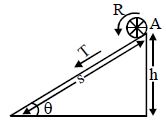
Suppose a body of mass $M$ and radius $R$ is allowed to roll on an inclined plane without slipping from its topmost point $A$. The velocity acquired by the body, as it reaches the bottom of the inclined plane, is given by $\beta  = 1 + \frac{I}{{M{R^2}}}$
A $5.0\, amp$ current is setup in an external circuit by a $6.0\, volt$ storage battery for $6.0$ minutes. The chemical energy of the battery is reduced by
Radio wave diffract around building although light waves do not. The reason is that radio waves