Question
Electronic configuration of some elements is given in Column I and their electron gain enthalpies are given in Column II. Match the electronic configuration with electron gain enthalpy:
 
Column (I)
 
Column (II)
 
Electronic configuration
 
Electron gain enthalpy/ kJ $mol^{-1}$
i.
$1s^2 2s^2 sp^6$
A.
-53
ii.
$1s^2 2s^2 2p^6 3s^1$
B.
-328
iii.
$1s^2 2s^2 2p^5$
C.
-141
iv.
$1s^2 2s^2 2p^4​​​​​​​$
D.
+48

Answer

 
Column (I)
 
Column (II)
 
Electronic configuration
 
Electron gain enthalpy/ kJ $mol^{-1}$
i.
$1s^2 2s^2 sp^6$
A.
+48
ii.
$1s^2 2s^2 2p^6 3s^1$
B.
-53
iii.
$1s^2 2s^2 2p^5$
C.
-328
iv.
$1s^2 2s^2 2p^4$
D.
-141

Need a full question paper?

Generate a complete, print-ready paper with questions like this in minutes — across 16+ boards, with answer keys.

Start Generating Free

Similar questions

  1. Use the following reactions to arrange the elements A, B, C and D in order of their redox reactivity:
  1. $A + B^+ \rightarrow At + B$
  2. $B + D^+ \rightarrow B^+ +D$
  3. $C^+ + D \rightarrow$ No reaction
  4. $B^+C^+ \rightarrow B^+ + C$
  1. On the basis of above redox activity series, predict which of the following reactions would you expect to occur?
  1. $A^+ + C \rightarrow A^+ C^+$
  2. $A^+ + D \rightarrow A^+ D^+$
Which out of $\mathrm{NH}_3$ and $\mathrm{NF}_3$ has higher dipole moment and why?
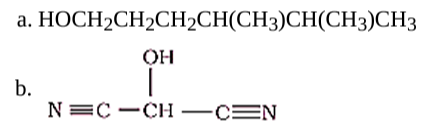
1. For each of the following compounds, write a condensed formula and also their bond-line formula.
Image
2. How does
i. an electron withdrawing group (EWG) and
ii. an electron donating group (EDG) influence the acid strength of carboxylic end?
Using electron transfer concept, identify the oxidant and reductant in the following redox reactions.
  1. $\text{Zn(s)}+2\text{H}^+\text{(aq)}\xrightarrow{\ \ \ \ \ \ \ \ \ }\text{Zn}^{2+}\text{(aq)}+\text{H}_2\text{(g)}$
  2. $2[\text{Fe}(\text{CN})_6]^{4-}\text{(aq)}+\text{H}_2\text{O}_2\text{(aq)}+2\text{H}^+\text{(aq)}\\\xrightarrow{\ \ \ \ \ \ }2[\text{Fe}\text{(CN)}_6]^{3-}\text{(aq)}+2\text{H}_2\text{O}\text{(l)}$
  3. $2[\text{Fe(CN)}_6]^{3-}\text{(aq)}+2\text{OH}^-\text{(aq)}+\text{H}_2\text{O}_2(\text{aq})\\\xrightarrow{\ \ \ \ \ \ \ \ }2[\text{Fe(CN)}_6]^{4-}\text{(aq)}+\text{O}_2 (\text{g}) +2\text{H}_2\text{(l)}$
  4. $\text{BrO}^-_3\text{(aq)}+\text{F}_2\text{(g)}+\text{2OH}^-\text{(aq)}\xrightarrow{\ \ \ \ \ \ \ \ }\\\text{BrO}^-_4\text{(aq)}+\text{F}^-\text{(aq)}+\text{H}_2\text{O(l)}$
  5. $2\text{NaClO}_3(\text{aq})+\text{I}_2\text{(aq)}\xrightarrow{\ \ \ \ \ \ \ }\text{2NaIO}_3\text{(aq)}+\text{Cl}_2\text{(g)}$
What are metallic/ interstitial hydrides? How do they differ from molecular hydrides?
A welding fuel gas contains carbon and hydrogen only. Burning a small sample of it in oxygen gives 3.38g carbon dioxide, 0.690 g of water and no other products. A volume of 10.0L (measured at STP) of this welding gas is found to weigh 11.6g. Calculate.
  1. Empirical formula.
  2. Molar mass of the gas.
  3. Molecular formula.
What is Fajan's law? Also describe the factors affecting it.
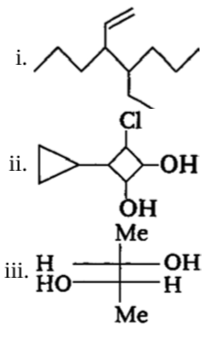
1. Give IUPAC names of the following structures.
Image
2. Benzoic acid is an organic compound. Its crude sample can be purified by crystallization from hot water. What characteristic differences in the properties of benzoic acid and the impurity make this process of purification suitable?
What are significant figures? State rules to determine it.
Explain the following:
  1. Silicones are used for making water proof fabrics.
  2. Boron does not form $B^{3+}$ ion.
  3. Boric acid is considered as a weak acid.
  4. Carbon forms covalent compounds while lead forms ionic compounds.
  5. Graphite is used as a lubricant.