Question
Explain the following:
  1. Silicones are used for making water proof fabrics.
  2. Boron does not form $B^{3+}$ ion.
  3. Boric acid is considered as a weak acid.
  4. Carbon forms covalent compounds while lead forms ionic compounds.
  5. Graphite is used as a lubricant.

Answer

  1. Silicones are synthetic polymers containing repeated units of $R_2SiO$ where 'R' is alkyl group. Therefore are water repellants i.e. do not absorb water and are used for making water proof fabrics.
  2. Boron has small size and very high 3rd ionisation energy. Therefore $B^{3+}$ ion does not form.
  3. Boron is metalloid so $B_2O_3$ is weakly acidic, boric acid does not ionize completely in aqueous solution due to less ionic character. It accepts a pair of electrons from OH ion. Hence boric acid is weak acid.
$\text{H}-\text{OH}+\text{B(OH})_3\xrightarrow{\ \ \ \ \ \ \ \ }[\text{B(OH})_4]^-+\text{H}^+$
  1. 'C' has small size and high ionisation energy. Therefore forms covalent compound whereas 'Pb' has bigger size. Therefore has low ionisation energy, so it forms ionic compound.
  2. Graphite is soft and slippery and have high melting point. That's why it is used as lubricant in machine parts to reduce friction.

Need a full question paper?

Generate a complete, print-ready paper with questions like this in minutes — across 16+ boards, with answer keys.

Start Generating Free

Similar questions

Explain the general mechanism of electrophilic substitution of benzene.
Which important property did Mendeleev use to classify the elements in his periodictable and did he stick to that?
1. Describe the effect of
a. addition of $H _2$
b. addition of $CH _3 OH$
c. removal of CO
d. removal of $CH _3 OH$ on the equilibrium of the reaction,
$
2 H_2(g)+CO(g) \rightleftharpoons CH_3 OH(g)
$
2. What happens to an equilibrium in a reversible reaction if a catalyst is added to it?
Arrange in properties:
  1. $HF, HCI, HBr, HI$ [Thermal stability]
  2. $LiF, LiCI, LiBr, Lil$ [Ionic character]
  3. $PH_3, PCI_3, PF_3,$ [Covalent character]
  4. $H_2O, NH_3, H_2S, HF$ [Polarity]
  5. $BeCl_2, BCI_3, CCI_4, PCI_3,$ [Bond angle]
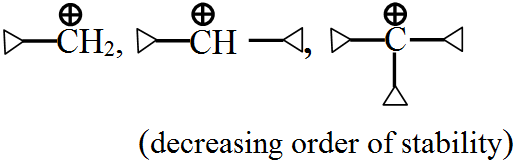
  1. Arrange the following according to given property
$\text{CH}_3\stackrel{\oplus \ \ \ }{\text{CH}}_2,\text{C}_6\text{H}_5-\stackrel{\oplus\ \ \ \ }{\text{CH}}_2,(\text{CH}_3)_3\stackrel{\oplus \ \ \ \ }{\text{CH}},$
$\text{CH}_2=\text{CH}-\stackrel{\oplus\ \ \ \ }{\text{CH}}_2$ (decreasing order of stability)
  1. $\text{HC}\equiv\text{C}^{\ominus},\text{Ch}_2=\stackrel{\ominus\ \ \ \ \ \ }{\text{CH}_2},\text{CH}_3-\stackrel{\ominus\ \ \ \ \ }{\text{CH}_2},\stackrel{\ominus \ \ \ \ \ }{\text{CH}_3}$ (increasing order of stabillity)
  2. $\text{C}_6\text{H}_5\stackrel{\bf. \ \ \ \ }{\text{CHCH}_3},\text{C}_6\text{H}_5\text{CH}_2\stackrel{\bf.\ \ \ \ \ }{\text{CH}_2},\text{C}_6\text{H}_5\stackrel{\bf.}{\text{C}}_3(\text{CH}_3)_2$ (increasing order of stabillity)
  3. $\text{CH}_3-\stackrel{\oplus \ \ \ \ }{\text{CH}}-\text{O}-\text{CH}_3,\text{CH}_3-\stackrel{\oplus \ \ \ \ }{\text{CH}},-\text{OCH}_3,$
${\ \ \ \ \ \ \ \ \ \ \ \ \ \ \ \ \ \ \ \ \text{O}}\\{\ \ \ \ \ \ \ \\ \ \ \ \ \ \ \ \ \ \ \ \ \ \\ \|}\\\ \text{CH}_3-\stackrel{\oplus \ \ \ \ }{\text{CH}}\text{C}-\text{OCH}_3$ (decreasing order of stability)
  1.  
Do you observe any soil pollution in your neighbourhood? What efforts will you make for controlling the soil pollution?
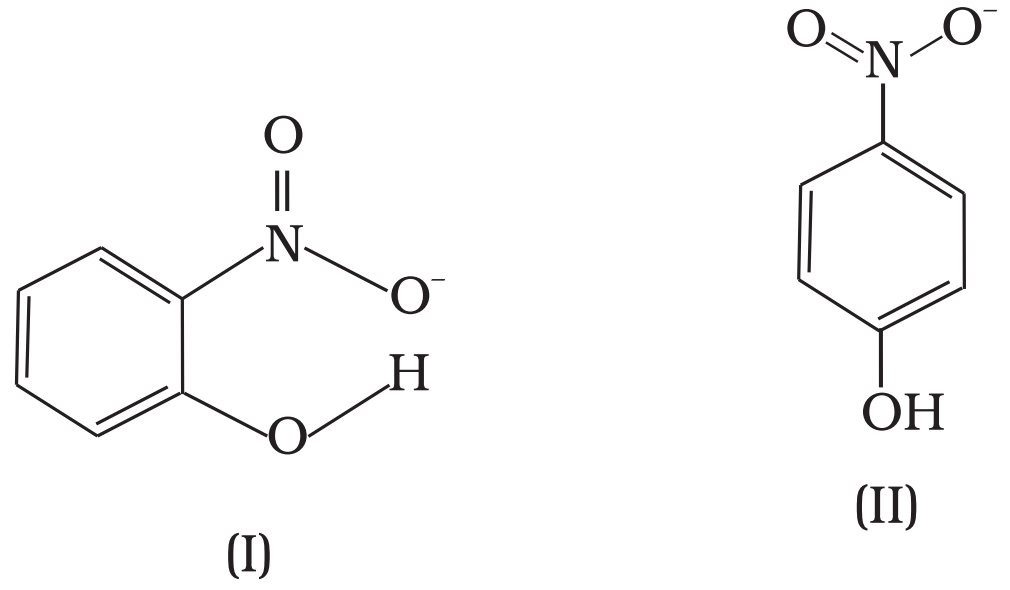
Structures of molecules of two compounds are given below:
  1. Which of the two compounds will have intermolccular hydrogen bonding and which compound is expected to show intramolecular hydrogen bonding?
  2. The melting point of a compound depends on. among other things, the extent of hydrogen bonding. On this basis explain which of the above two compounds will show higher melting point.
  3. Solubility of compounds in water depends on power to form hydrogen bonds with water. Which of the above compounds will form hydrogen bond with water easily and be more soluble in it?
What characteristics do you expect from an electron-deficient hydride with respect to its structure and chemical reactions?
In terms of Charles’ law explain why –273 °C is the lowest possible temperature.
What are the harmful effects of photochemical smog and how can they be controlled?