Question
Electrons are emitted from the surface when green light is incident on it, but no electrons are ejected when yellow light is incident on it. Do you expect electrons to be ejected when surface is exposed to (i) Red light and (ii) Blue light?

Answer

  1. The wavelength of red light is longer than threshold wavelength, hence no electron will be emitted with red light.
  2. The wavelength of blue light is smaller than threshold wavelength, hence electrons will be ejected.

Need a full question paper?

Generate a complete, print-ready paper with questions like this in minutes — across 16+ boards, with answer keys.
Start Generating Free

Similar questions

The wavelength $\lambda$ of a photon and the de-Broglie wavelength of an electron have the same value. Show that energy of a photon is (2$\lambda$mc/h) times the kinetic energy of electron; where m, c and h have their usual meaning.
A small metal sphere with $+Q$ charge is placed in the cavity of a larger uncharged metal sphere. As shown in the Fig. Find the value of electric field intensity at point $P_1$ and $P_2$ from Gauss's law.
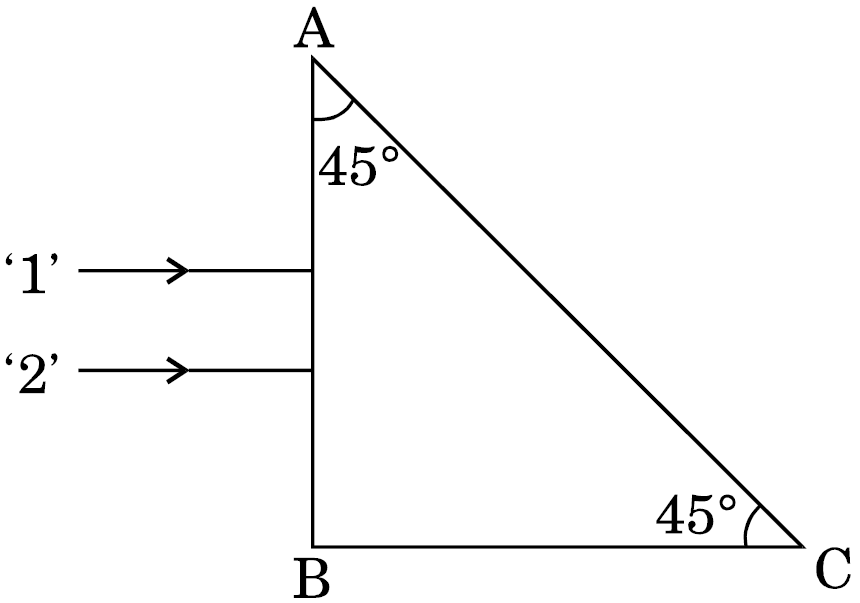
Two monochromatic rays of light are incident normally on the face AB of an isosceles right-angled prism ABC. The refractive indices of the glass prism for the two rays ‘1’ and ‘2’ are respectively 1.38 and 1.52. Trace the path of these rays after entering through the prism.
White light is used in a Young's double slit experiment. Find the minimum order of the violet fringe $(\lambda=400\ \text{nm}),$ which overlaps with a red fringe $(\lambda=700\ \text{nm}).$
Let I = current through a conductor, R = its resistance and V = potential difference across its ends. According to Ohm's law, product of two of these quantities equals the third. Obtain Ohm's law from dimensional analysis. Dimensional formulae for R and V are $\text{ML}^2\text{I}^{-2}\text{T}^{-3}$ and $\text{ML}^2\text{T}^{-3}\text{I}^{-1}$ respectively.
Write the characteristics of electric field lines.
Derive the formula of torque for electric dipole placed in uniform electric field. $\#\#\#$ Explain behaviour of a dipole in a uniform electric field.
Derive the condition of Constructive and destructive interference in terms of the phase difference.
The circuit arrangement given below shows that when an a.c. passes through the coil A, the current starts flowing in the coil B.
  1. State the underlying principle involved.
  2. Mention two factors on which the current produced in the coil B depends.
Why is a white dress more comfortable than a dark dress in summer?