Question
Electrons emitted with negligible speed from an electron gun are accelerated through a potential difference V along the x-axis. These electrons emerge from a narrow hole into a uniform magnetic field B directed along this axis. However, some of the electrons emerging from the hole make slightly divergent angles, as shown in the figure. Show that these paraxial electrons are refocussed on the x-axis at a distance $\sqrt{\frac{8\pi^2\text{mV}}{\text{eB}^2}}.$
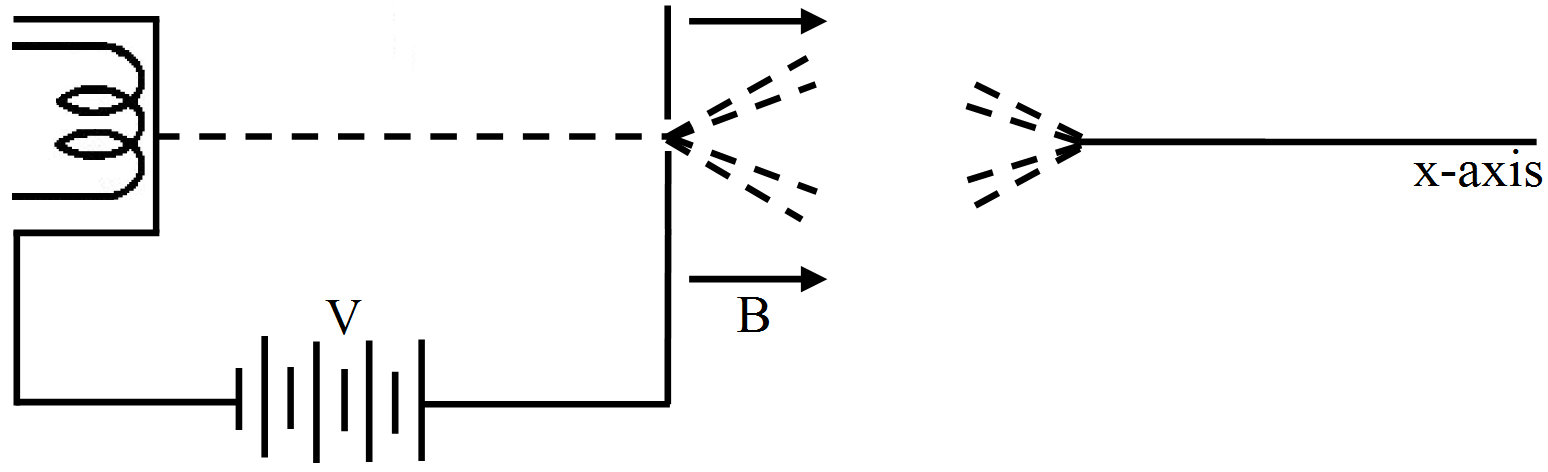
Answer

Given magnetic field = B, Pd = V, mass of electron = m, Charge = q, Let electric field be ‘E’
$\therefore\text{E}=\frac{\text{V}}{\text{R}'}$
Force Experienced = eE Acceleration $=\frac{\text{eE}}{\text{m}}=\frac{\text{eE}}{\text{Rm}}$ Now, $V^2 = 2 \times a \times s$
$[\because\text{x}=0]$
$\text{V}=\sqrt{\frac{2\text{e}\times\text{V}\times\text{R}}{\text{Rm}}}=\sqrt{\frac{\text{2eV}}{\text{m}}}$
Time taken by particle to cover the arc $=\frac{2\pi\text{m}}{\text{qB}}=\frac{2\pi\text{m}}{\text{eB}}$ Since the acceleration is along ‘Y’ axis. Hence it travels along x axis in uniform velocity, Therefore, $\text{v}\times\text{t}=\sqrt{\frac{2\text{em}}{\text{m}}}\times\frac{2\pi\text{m}}{\text{eB}}\sqrt{\frac{8\pi^2\text{mV}}{\text{eB}^2}}$

Need a full question paper?

Generate a complete, print-ready paper with questions like this in minutes — across 16+ boards, with answer keys.

Start Generating Free

Similar questions

Obtain a relation between the distance travelled by a body in time t, if its initial velocity be u and acceleration:
Consider a one-dimensional motion of a particle with total energy E. There are four regions A, B, C and D in which the relation between potential energy V, kinetic energy (K) and total energy E is as given below:
Region A : V > E
Region B : V < E
Region C : K > E
Region D : V > K
State with reason in each case whether a particle can be found in the given region or not.
A fighter plane flying horizontally at an altitude of $1.5km$ with speed $720km/h$ passes directly overhead an anti-aircraft gun. At what angle from the vertical should the gun be fired for the shell with muzzle speed $600ms^{-1}$ to hit the plane? At what minimum altitude should the pilot fly the plane to avoid being hit? (Take $g = 10ms^{-2}$).
Suppose the particle of the previous problem has a mass m and a speed v before the collision and it sticks to the rod after the collision. The rod has a mass $M$:
  1. Find the velocity of the centre of mass C of the system constituting ''The rod plus the particle''.
  2. Find the velocity of the particle with respect to C before the collision.
  3. Find the velocity of the rod with respect to C before the collision.
  4. Find the angular momentum of the particle and of the rod about the centre of mass C before the collision.
  5. Find the moment of inertia of the system about the vertical axis through the centre of mass C after the collision.
  6. Find the velocity of the centre of mass C and the angular velocity of the system about the centre of mass after the collision.
Prove that :
(i) Inside the liquid the pressure is higher than on the open surface of the liquid.
(ii) The pressure difference between any two points in a vertical line inside the liquid occurs only due to the effect of gravity.
A lead bullet penetrates into a solid object and melts. Assuming that $50\%$ of the K.E. was used to heat it, calculate the initial speed of the bullet. The initial temperature of bullet is $27°C$ and its melting point is $327°C$. Latent heat of fusion of lead = $2.5 \times 10^4J kg^{-1}$ and specific heat capacity of lead = $125J kg^{-1}K^{-1}​​​​​​​$.
Consider an ideal gas with following distribution of speeds.
Speed m/s
200
400
600
800
1000
% of molecules
10
20
40
20
10
Calculate $V_{rms}$ and hence T. $(m = 3.0 \times 10^{-26}kg)$
A normal eye has retina 2cm behind the eye-lens. What is the power of the eye-lens when the eye is
  1. Fully relaxed,
  2. Most strained?
From a uniform circular disc of diameter d, a circular hole of diameter $\frac{\text{d}}{6}$ and having its centre at a distance of $\frac{\text{d}}{4}$ from the centre of the disc is scooped out. Find the centre of mass of the remaining portion.
Show analytically that work done by one mole of an ideal gas during isothermal expansion from volume $V_1$ to volume $V_2$​​​​​​​ is given by, $\text{W}=\text{RT}\log_\text{e}\Big(\frac{\text{V}_2}{\text{V}_1}\Big)$