From a uniform circular disc of diameter d, a circular hole of diameter $\frac{\text{d}}{6}$ and having its centre at a distance of $\frac{\text{d}}{4}$ from the centre of the disc is scooped out. Find the centre of mass of the remaining portion.
Download our app for free and get started
Let the mass per unit area of the disc be m. Then, Mass of the disc, $\text{M}=\pi\Big(\frac{\text{d}}{2}\Big)^2\text{m}=\frac{\pi\text{md}^2}{4}$ Mass of the scooped out portion of the disc, $\text{M}=\pi\Big(\frac{\text{d}}{12}\Big)^2\text{m}=\frac{\pi\text{md}^2}{144}$ Let us take the centre of the disc O as origin. The masses M and M' are supposed to be concentrated at their respective centres of the disc and scooped out portion. Since the portion is removed, its mass M' will be represented by negative sign. Then x-coordinate of the COM of the remaining portion of the disc is given by, $\text{x}=\frac{\text{Mx}_1-\text{M}'\text{x}_2}{\text{M}-\text{M}}$ $=\frac{\text{M}\times0-\text{M}'\times\frac{\text{d}}{4}}{\frac{\pi\text{md}^2}{4}-\frac{\pi\text{md}^2}{144}}$ $=\frac{-\text{M}'\text{d}}{4}\times\frac{144}{35\pi\text{md}^2}$ $=\frac{-\pi\text{md}^2}{144}\frac{\text{d}}{4}\frac{144}{35\pi\text{md}^2}$ $=\frac{-\text{d}}{140}$ i.e., the COM of the remaining portion of the disc is at a distance of $\frac{-\text{d}}{140}$towards left of the orign O.

Download our appand get started for free
Experience the future of education. Simply download our apps or reach out to us for more information. Let's shape the future of learning together!No signup needed.*
Similar Questions
- 1A uniform wheel of radius R is set into rotation about its axis at an angular speed $\omega.$ This rotating wheel is now placed on a rough horizontal surface with its axis horizontal. Because of friction at the contact, the wheel accelerates forward and its rotation decelerates till the wheel starts pure rolling on the surface. Find the linear speed of the wheel after it starts pure rolling.View Solution
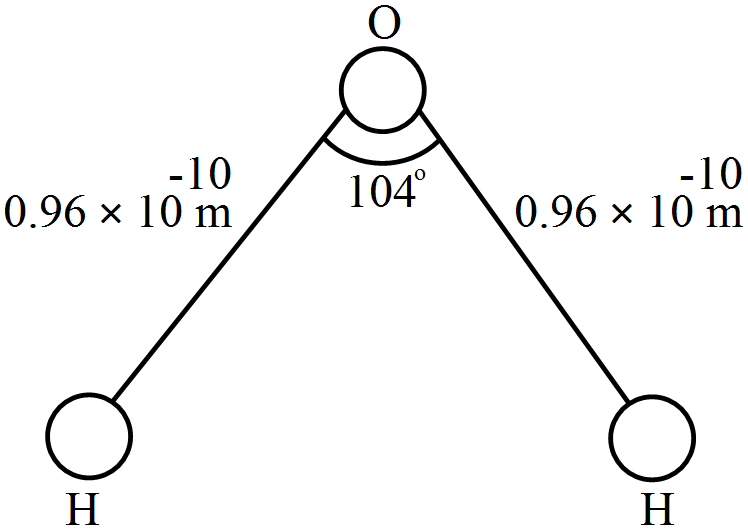
- 2View SolutionThe structure of a water molecule is shown in figure. Find the distance of the centre of mass of the molecule from the centre of the oxygen atom.
- 3An electron of mass $9 \times 10^{-31}kg$ revolves in a circle of radius $0.53\mathring{\text{A}}$ around the nucleus of hydrogen with a velocity of $2.2 \times 10^6ms$. Show that angular momentum of elect ron is $\frac{\text{h}}{2\pi}$ where h is Planck's constant.View Solution
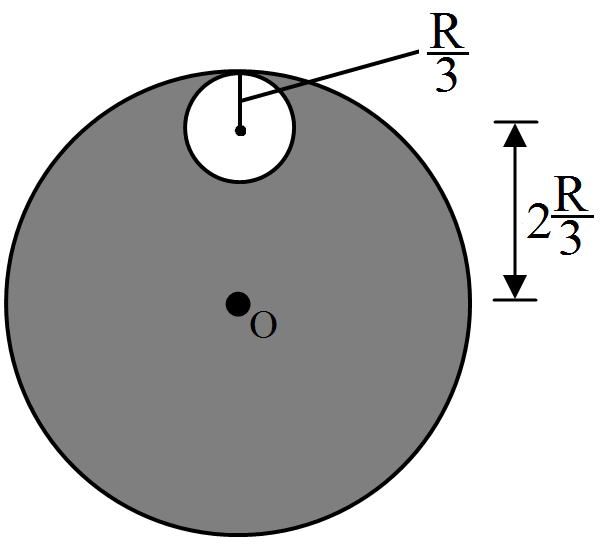
- 4From a circular disc of radius R and mass 9M, a small disc of radius $\frac{\text{R}}{3}$ is removed as shown in Fig. Find the moment of inertia of the remaining disc about an axis perpendicular to the plane of the disc and passing through the point O.View Solution
- 5Particles of masses $1g, 2g, 3g, ........, 100g$ are kept at the marks $1cm, 2cm, 3cm, ........, 100cm$ respectively on a metre scale. Find the moment of inertia of the system of particles about a perpendicular bisector of the metre scale.View Solution
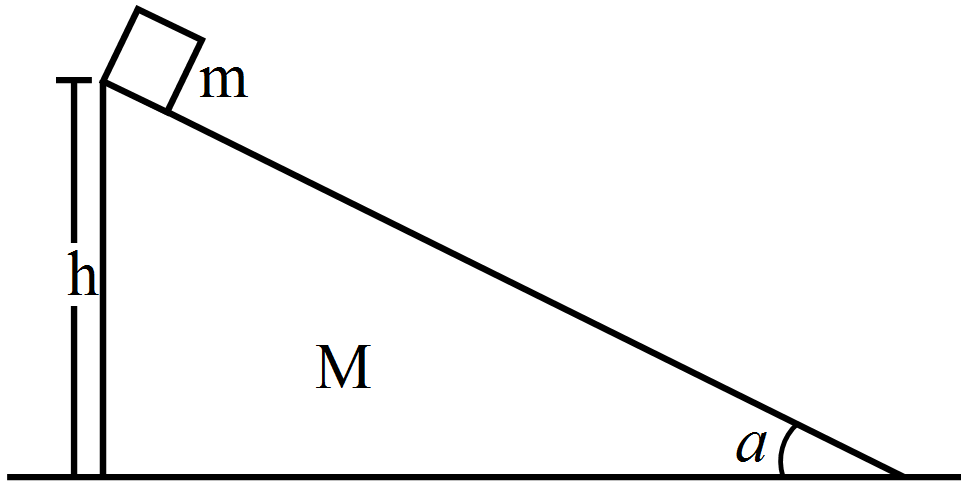
- 6View SolutionA block of mass m is placed on a triangular block of mass M, which in turn is placed on a horizontal surface as shown in figure. Assuming frictionless surfaces find the velocity of the triangular block when the smaller block reaches the bottom end.
- 7View SolutionObtain an expression for linear acceleration of a cylinder rolling down an inclined plane and hence find the condition for the cylinder to roll down the inclined plane without slipping.
- 8View SolutionA ball is whirled in a circle by attaching it to a fixed point with a string. Is there an angular rotation of the ball about its centre? If yes, is this angular velocity equal to the angular velocity of the ball about the fixed point?
- 9View SolutionTwo particles, each of mass m and speed v, travel in opposite directions along parallel lines separated by a distance d. Show that the angular momentum vector of the two particle system is the same whatever be the point about which the angular momentum is taken.
- 10View SolutionA wheel in uniform motion about an axis passing through its centre and perpendicular to its plane is considered to be in mechanical (translational plus rotational) equilibrium because no net external force or torque is required to sustain its motion. However, the particles that constitute the wheel do experience a centripetal acceleration directed towards the centre.How do you reconcile this fact with the wheel being in equilibrium? How would you set a half-wheel into uniform motion about an axis passing through the centre of mass of the wheel and perpendicular to its plane? Will you require external forces to sustain the motion?