Electrons moving with different speeds enter a uniform magnetic field in a direction perpendicular to the field. They will move along circular paths.
Medium


Download our appand get started for free
Experience the future of education. Simply download our apps or reach out to us for more information. Let's shape the future of learning together!No signup needed.*
Similar Questions
- 1A charge $q$ is released in presence of electric $(E)$ and magnetic field $(B)$ then after some time its velocity is $v$ thenView Solution
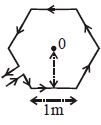
- 2The current of $1\,A$ is passed through a hexagonal conducting wire of side $1\,m$ . The magnetic induction at its centre $O$ in $Wb/m^2$ will beView Solution
- 3An electron is moving along the positive $X$$-$axis. You want to apply a magnetic field for a short time so that the electron may reverse its direction and move parallel to the negative $X$$-$axis. This can be done by applying the magnetic field alongView Solution
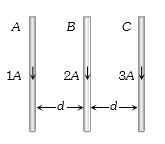
- 4There long straight wires $A$, $B$ and $C$ are carrying current as shown figure. Then the resultant force on $B$ is directed .....View Solution
- 5An electron is moving along $+x$ direction with a velocity of $6 \times 10^{6}\, ms ^{-1}$. It enters a region of uniform electric field of $300 \,V / cm$ pointing along $+ y$ direction. The magnitude and direction of the magnetic field set up in this region such that the electron keeps moving along the $x$ direction will beView Solution
- 6A circular coil ‘$A$’ has a radius $R$ and the current flowing through it is $I$. Another circular coil ‘$B$’ has a radius $2R$ and if $2I$ is the current flowing through it, then the magnetic fields at the centre of the circular coil are in the ratio of (i.e.${B_A}$ to ${B_B}$)View Solution
- 7A voltmeter of resistance $1000\,\Omega $ gives full scale deflection when a current of $100\, mA$ flow through it. The shunt resistance required across it to enable it to be used as an ammeter reading $1\, A$ at full scale deflection is ............... $\Omega $View Solution
- 8In order to pass $10\,\%$ of main current through a moving coil galvanometer of $99\, ohm$, the resistance of the required shunt is ............ $\Omega $View Solution
- 9View SolutionAn electron enters a magnetic field whose direction is perpendicular to the velocity of the electron. Then
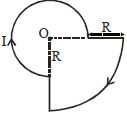
- 10A current $I$ flowing through the loop as shown in the adjoining figure. The magnetic field at centre $O$ isView Solution