MCQ
Electroplating does not help in
  • A
    Fine finish to the surface
  • B
    Shining appearance
  • Metals to become hard
  • D
    Protect metal against corrosion

Answer

Correct option: C.
Metals to become hard
(c) Metals to become hard

Need a full question paper?

Generate a complete, print-ready paper with questions like this in minutes — across 16+ boards, with answer keys.
Start Generating Free

Similar questions

The photo-electrons emitted from a surface of sodium metal are such that
The Fraunhoffer ‘diffraction’ pattern of a single slit is formed in the focal plane of a lens of focal length $1\,m$. The width of slit is $0.3\,mm$. If third minimum is formed at a distance of $5\,mm$ from central maximum, then wavelength of light will be......$\mathop A\limits^o $
The distance of an object from the pole of a concave mirror is equal to its radius of curvature . The image must be :
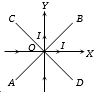
Two very thin metallic wires placed along $X$ and $Y$-axis carry equal currents as shown here. $AB$ and $CD$ are lines at $45^\circ $ with the axes with origin of axes at $O$. The magnetic field will be zero on the line
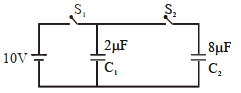
A $2\, \mu F$ capacitor $C _{1}$ is first charged to a potential difference of $10\, V$ using a battery.Then the battery is removed and the capacitor is connected to an uncharged capacitor $C _{2}$ of $8\, \mu F$. The charge in $C _{2}$ on equilibrium condition is $\ldots\,\mu C$. (Round off to the Nearest Integer)
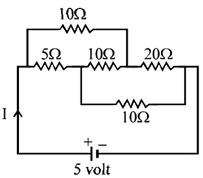
The current $I$ drawn from the $5$ volt source will be ............... $A$
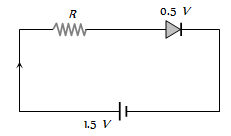
The diode used in the circuit shown in the figure has a constant voltage drop of 0.5 V at all currents and a maximum power rating of 100 milliwatts. What should be the value of the resistor R, connected in series with the diode for obtaining maximum current
A convex lens is made of a material having refractive index $1.2.$ Both the surfaces of the lens are convex. If it is dipped into water $(\mu=1.33),$ it will behave like:
A charge of $10\, e.s.u.$ is placed at a distance of $2\, cm$ from a charge of $40\, e.s.u.$ and $4\, cm$ from another charge of $20\, e.s.u.$ The potential energy of the charge $10\, e.s.u.$ is (in $ergs$)
An object is placed at $20cm$ from a convex mirror of focal length $10\,cm.$ The image formed by the mirror is