MCQ
Electrovalent bond formation depends on
  • A
    IonizatioElectron affinityenergy
  • B
    Electron affinity
  • C
    Lattice energy
  • All the three above

Answer

Correct option: D.
All the three above
d
Electrovalent bond formation depends on ionization energy of cation, electron affinity of anion and on lattice energy

Need a full question paper?

Generate a complete, print-ready paper with questions like this in minutes — across 16+ boards, with answer keys.

Start Generating Free

Similar questions

The $(e/m)$ for positive rays in comparison to cathode rays is
If the concentration of $OH^-$ ions in the reaction

$Fe(OH)_{3(s)} \rightleftharpoons  Fe^{3+}_{(aq)} + 3OH^-_{(aq)}$

is decreased by $1/4$ times, then equilibrium concentration of $Fe^{3+}$ will increase by.....$ times$

Which of the following is the Fischer projection of $L-$ threonine (also known as  $(2S, 3R) \, 2-$ amino $-3-$ hydroxybutanoic acid) ?
Given the reaction between $2$ gases represented by $A_2$ and $B$ to give the compound $AB_{(g)}$ 

$A_{2(g)} + B_{2(g)} \rightleftharpoons  2AB_{(g)}$

At equilibrium, the concentration of $A_2= 3.0 \times 10^{-3} \, M,$ of $B_2= 4.2 \times 10^{-3} \, M,$ of $AB= 2.8 \times 10^{-3} \, M,$

If the reaction takes place in a sealed vessel at $527^o C,$ then the value of $K_c$ will be

Which one of the following statements is true for ammonium ion
The hydrolysis of an ester was carried out separately with $0.1\ N$ $HCl$ and $0.1\ N$ $H_2SO_4$ . Then for rate of reaction $(R)$ in the presence of acid which of the following relation is true
For the reaction$C{H_3}COOH(l) + 2{O_2}(g)$ $\rightleftharpoons$ $2C{O_2}(g) + 2{H_2}O(l)$ at ${25\,^o}C$ and $1 \,atm$ . pressure, $\Delta H = - 874\,kJ.$ Then the change in internal energy $(\Delta E)$ is ….$kJ$
What will be the molarity of a solution, which contains $5.85g$ of $\ce{NaCl(s)}$ per $500\ mL\ ?$
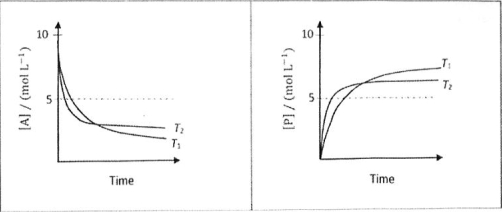
For a reaction, $A \rightleftharpoons P$, the plots of $[ A ]$ and $[ P ]$ with time at temperatures $T _1$ and $T _2$ are given below.

If $T _2> T _1$, the correct statement(s) is (are)

(Assume $\Delta H ^{\ominus}$ and $\Delta S ^{\ominus}$ are independent of temperature and ratio of $\ln K$ at $T _1$ to $\ln K$ at $T_2$ is greater than $T_2 / T_1$. Here $H, S, G$ and $K$ are enthalpy, entropy, Gibbs energy and equillibrium constant, respectively.)

$(A)$ $\Delta H ^{\ominus}<0, \Delta S ^{\ominus}<0$  $(B)$ $\Delta G ^{\ominus}<0, \Delta H ^{\ominus}>0$  $(C)$ $\Delta G ^{\ominus}<0, \Delta S ^{\ominus}<0$  $(D)$ $\Delta G ^{\ominus}<0, \Delta S ^{\ominus}>0$

Product $B$ may be :