Question
Elements upto atomic number $103$  have been synthesized and studied. If a newly discovered element is found to have an atomic number $106,$  its electronic configuration will be

Answer

d
(d) $Un{h_{106}} = [Rn]\,5{f^{14}},\,6{d^5},\,7{s^1}$

Need a full question paper?

Generate a complete, print-ready paper with questions like this in minutes — across 16+ boards, with answer keys.
Start Generating Free

Similar questions

The sum of the oxidation numbers of all the carbons in ${C_6}{H_5}CHO$ is
Methanol can be distinguish from ethanol by
When the concentration of a reactant, $A$, in a reaction : $A \to$ Products is doubled, the  rate of reaction increases seven times, the order of the reaction is between -
Which of the following molecules has axis of symmetry and a coaxial plane of symmetry ?
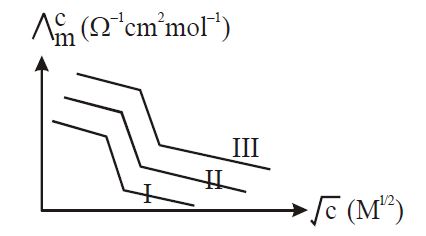
Three graphs for $R(CH_2)_nCOONa$ are as - Correct value of 'n' may be correctly matched as -
Addition of conc. $HCl$ to saturated $BaC{l_2}$ solution precipitates $BaC{l_2}$; because
Noble gases are named because of their inertness towards reactivity. Identify an incorrect statement about them.
In the reaction $BC{l_3} + P{H_3}\, \to \,C{l_3}B - P{H_3},$ Lewis base is
The bond dissociation energy of $B-F$ in $BF_3$ is $646\,kJ\,mol^{-1}$ whereas that of $C-F$ in $CF_4$ is $515\,kJ\,mol^{-1}$ . The correct reason for higher $B-F$ bond dissociation energy as compared to that of $C-F$ is
Match each coordination compound in List $-I$ with an appropriate pair of characteristics from List $-II$ and select the correct answer using the code given below the lists. $\{en$ $= H_2NCH_2CH_2NH_2$, atomic numbers : $Ti = 22; Cr = 24; Co = 27; Pt = 78$ $ \}$
  List$-I$   List$-II$
$(P)$ $[Cr(NH_3)_4Cl_2]Cl$ $(1)$ Paramagnetic and exhibits ionisation isomerism
$(Q)$ $[Ti(H_2O)_5Cl](NO_3)_2$ $(2)$ Diamagnetic and exhibits cis-trans isomerism
$(R)$ $[Pt(en)(NH_3)Cl]NO_3$ $(3)$ Paramagnetic and exhibits cis-trans isomerism
$(S)$ $[Co(NH_3)_4(NO_3)_2]NO_3$ $(4)$ Diamagnetic and exhibits ionisation isomerism